
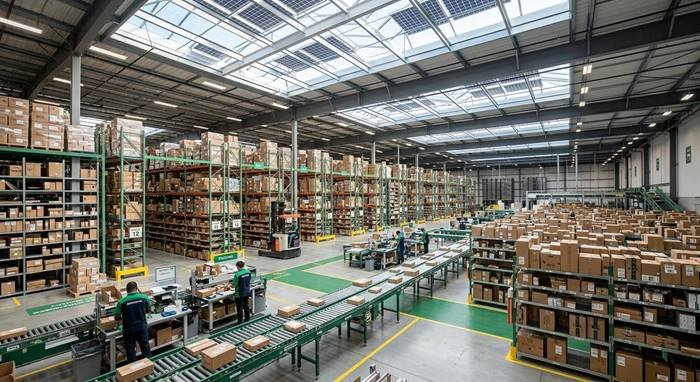
Most people don’t think about the carbon trail behind a two-day delivery. You click “buy,” and two days later a box appears on your doorstep. What happened in between – the warehouse energy, the packaging materials, the trucks, the failed delivery attempts, the returns – is largely invisible to consumers, and until recently, to many ecommerce brands too.
That invisibility has a cost. According to a World Economic Forum and McKinsey joint analysis, last-mile delivery emissions in the top 100 cities globally are projected to grow more than 30% by 2030. Parcel and freight shipping alone could generate 25 million metric tons of CO2 by the end of this decade – comparable to the annual output of the global cement industry. These aren’t distant corporate projections. They’re the direct consequence of how ecommerce orders get packed, moved, and delivered.
The good news is that the fulfillment stage, including warehousing, packaging, transportation, and returns, is also where ecommerce brands have the most control. Smart choices at this level produce measurable emissions reductions. The rest of this article breaks down where the biggest gains are, what the data shows, and why choosing the right fulfillment partner is one of the most meaningful decisions an ecommerce brand can make.
The Hidden Environmental Cost of Ecommerce Fulfillment
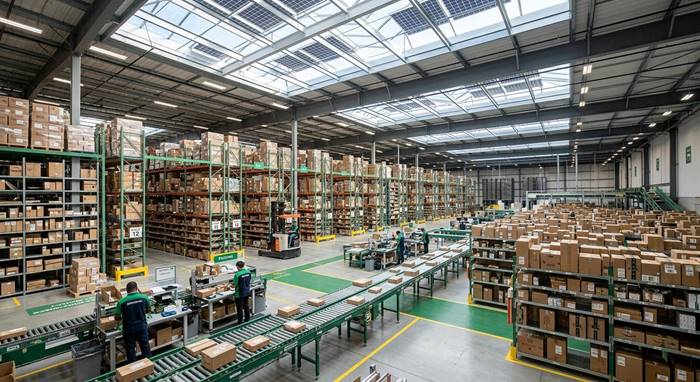
Ecommerce brands tend to focus their sustainability attention on packaging, because it’s what customers see. But packaging is only one piece. McKinsey research found that transport and distribution account for about 22% of emissions across seven large ecommerce players studied. Warehousing, lighting, HVAC, refrigeration, and the energy demands of robotic picking systems add more. Returns logistics – one of the least-discussed parts of the supply chain – can effectively double the carbon cost of a transaction when items travel back through the network.
For brands ready to act, the question becomes practical: where do you start? Warehousing energy, packaging choices, delivery routes, and returns policies all matter, but you can’t fix them all in-house. Working with purpose-built fulfillment solutions with The Fulfillment Lab gives ecommerce businesses access to infrastructure-level sustainability capabilities – energy-efficient facilities, smarter packaging systems, multi-carrier routing – that take years to build independently. The right 3PL partner doesn’t just store your product; it changes the environmental profile of every order you ship.
Supply chain emissions, classified as Scope 3 under standard greenhouse gas accounting frameworks, make up 70 to 90% of a company’s total carbon footprint, according to the U.S. EPA’s Supply Chain Guidance. Most ecommerce brands haven’t measured their fulfillment-stage emissions at all. That’s starting to change – regulatory pressure is compressing the timeline. As of 2025, the Science Based Targets initiative (SBTi) reports that corporate net-zero commitments covering full value chains have grown significantly among the world’s largest companies, with accountability now extending into Scope 3 supplier emissions for the first time.
Eco-Friendly Packaging: Where Small Choices Have Big Impact

Packaging is the most visible part of the fulfillment problem for customers, and it’s also where some of the fastest gains are happening. Single-use plastic mailers, oversized boxes filled with air-pillow void fill, and non-recyclable composite materials still dominate the industry – but that’s shifting. Corrugated cardboard has consolidated its dominance because of its recyclability at scale – it’s the only high-volume packaging material with genuine end-of-life infrastructure already in place across major markets.
The change isn’t just material. It’s dimensional. Rightsizing – matching box dimensions to product dimensions rather than defaulting to standard box sizes – is one of the most straightforward wins in sustainable fulfillment. Reduced box volume means more packages per truck, fewer total trips, and lower fuel consumption across the delivery network. The Environmental Protection Agency’s supply chain guidance specifically calls out right-sizing as a primary packaging intervention for reducing ecommerce-related waste.
Consumer expectations are reinforcing this shift. A NielsenIQ study, cited in Digital Commerce 360’s March 2025 sustainable fulfillment report, found that 54% of consumers actively chose a product in the past six months specifically because of its sustainable packaging. That’s not aspirational preference data. It’s purchase behavior. For more on reducing packaging waste in shipping operations, our deep-dive on green shipping initiatives covers the operational specifics in detail.
Greener Warehouses and Smarter Inventory Management
The warehouse is often treated as a fixed cost – you rent the space, you fill it, you run the lights. But the energy profile of a fulfillment center is actually quite variable, depending on design choices and operational practices.
Leading distribution networks are already demonstrating what’s possible. REI’s Arizona distribution center operates at net zero. Target is installing solar panels across multiple distribution centers nationwide. Beyond renewable energy sourcing, automated storage and retrieval systems (AS/RS) and robotic pick-and-pack operations reduce per-unit energy draw compared with manual processes, because machines can operate in lower-light, lower-temperature environments.
Inventory placement strategy is less discussed but equally impactful. Distributed inventory – spreading stock across multiple fulfillment centers closer to end customers – cuts last-mile delivery distance at scale. Smart demand forecasting cuts overstock – and with it, the energy spent storing, handling, and eventually liquidating product that never sold. A WEF and McKinsey joint analysis found that an integrated approach to last-mile logistics – combining distributed inventory, route optimization, and consolidated delivery windows – could reduce delivery-related CO2 emissions by up to 30% by 2030.
Last-Mile Delivery: The Hardest Emissions Problem in Ecommerce
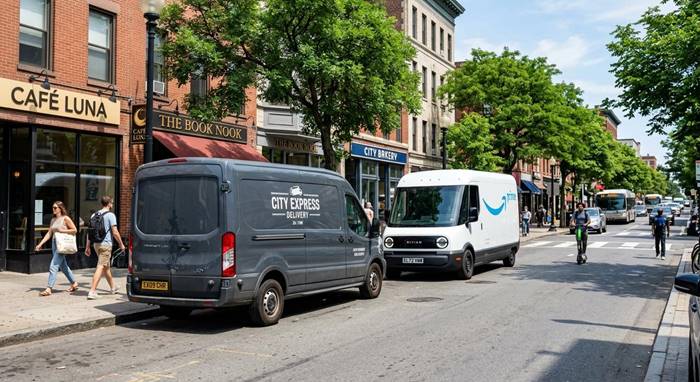
Last-mile delivery is the final and most expensive part of the logistics chain, and it’s where emissions are most concentrated. The WEF and McKinsey “Future of the Last-Mile Ecosystem” report projects that without systemic changes, the number of delivery vehicles in the top 100 cities will rise 36% by 2030, pushing emissions up 32%.
Several interventions are showing real results. Amazon has committed to deploying 100,000 electric delivery vans by 2030 through its partnership with Rivian. UPS’s ORION route optimization system saves the company about 100 million miles annually – translating directly into fuel and emissions savings. Walmart’s micro-fulfillment center pilots in urban areas reduced delivery emissions by up to 67% on routes served from those locations, because shorter trips and denser delivery windows reduce per-package carbon cost dramatically.
Route optimization software and multi-carrier selection tools let fulfillment operations route each individual shipment to the most efficient carrier for that specific origin-destination pair, rather than defaulting to a single carrier contract. That flexibility alone can meaningfully shift the emissions math across a high-volume operation.
The WEF and McKinsey joint analysis also concludes that an integrated last-mile ecosystem – combining route optimization, EV fleets, and consolidated delivery windows – could reduce delivery costs by 25% alongside the emissions reductions, according to the Future of the Last-Mile Ecosystem report.
Choosing a Fulfillment Partner That Takes Sustainability Seriously
Not all 3PLs treat sustainability as a core operating principle. Some add a “green” page to their website; others have rebuilt their facilities and carrier relationships around measurable emissions reduction. The difference matters because most ecommerce brands don’t have the scale or capital to build sustainable infrastructure independently – they inherit the environmental profile of whoever handles their fulfillment.
When evaluating a 3PL partner, the specifics to look for include ISO 14001 environmental management certification, LEED-certified warehouse facilities, and recognition under the EPA Green Power Partnership. Ask what percentage of the carrier network is electric or hybrid. Ask whether packaging audits are part of the service. Ask where fulfillment centers are located relative to your primary customer base – because proximity is one of the simplest levers for cutting last-mile emissions.
The business case for doing this well is no longer marginal. A NielsenIQ-sourced figure cited in the Digital Commerce 360 March 2025 report shows that 68% of global consumers are willing to pay more for sustainable products in at least one category. Brands that can’t demonstrate clean fulfillment credentials risk losing both consumer trust and B2B retail partnerships that increasingly require Scope 3 emissions documentation from suppliers.
The broader move toward sustainable supply chains isn’t just a compliance exercise. It’s becoming a baseline expectation in retail and B2B relationships, and the fulfillment stage is where most of that accountability lands.
Sustainable Fulfillment Is an Operational Decision, Not a Marketing Slogan
Ecommerce emissions don’t concentrate in one place. They’re distributed across every warehouse running lights overnight, every oversized box filled with plastic air pillows, every truck making a second delivery attempt because the first one failed. The carbon footprint of a single order is the sum of dozens of small operational choices, most of which happen before the package ever reaches a doorstep.
The brands making real progress on this aren’t offsetting their way to net zero – they’re changing how orders actually move. They’re redistributing inventory closer to customers, rightsizing packaging, switching carrier contracts, and working with fulfillment partners who’ve built sustainability into their operating model rather than retrofitted it as a marketing feature.
Consumer expectations and regulatory pressure are converging. Net-zero targets that cover full value chains are now standard policy at a growing share of the world’s largest companies, and the regulatory frameworks to enforce Scope 3 accountability are actively being developed in the EU and US. Ecommerce brands that get ahead of this now aren’t just being responsible, they’re avoiding the operational scramble that’s coming for everyone who waits.