
 Climate change is fueling an unprecedented number of extreme weather and climate disasters with dire consequences for human life and property. In the last decade, most counties across the United States have experienced multiple disaster events, including at least one federally declared disaster. States and local governments have a responsibility to adapt to these increasing disaster risks to improve community resilience and avoid an ever-growing magnitude of loss.
Congress passed the Stafford Act in 1988 to provide a means for sustained and coordinated federal aid in response to disasters. The Stafford Act, as amended, includes a comprehensive non-emergency hazard mitigation program. Hazard mitigation assistance empowers states, tribes, and local governments to engage in planning and mitigation activities that improve disaster outcomes and minimize losses in their jurisdictions. A key component of the Stafford Act’s hazard mitigation assistance programs, which are implemented by the Federal Emergency Management Agency (FEMA), is the development of state hazard mitigation plans. These plans play a critical role in ensuring that states “understand their natural hazard risks and develop long-term strategies to reduce risk, using a wide range of resources.”
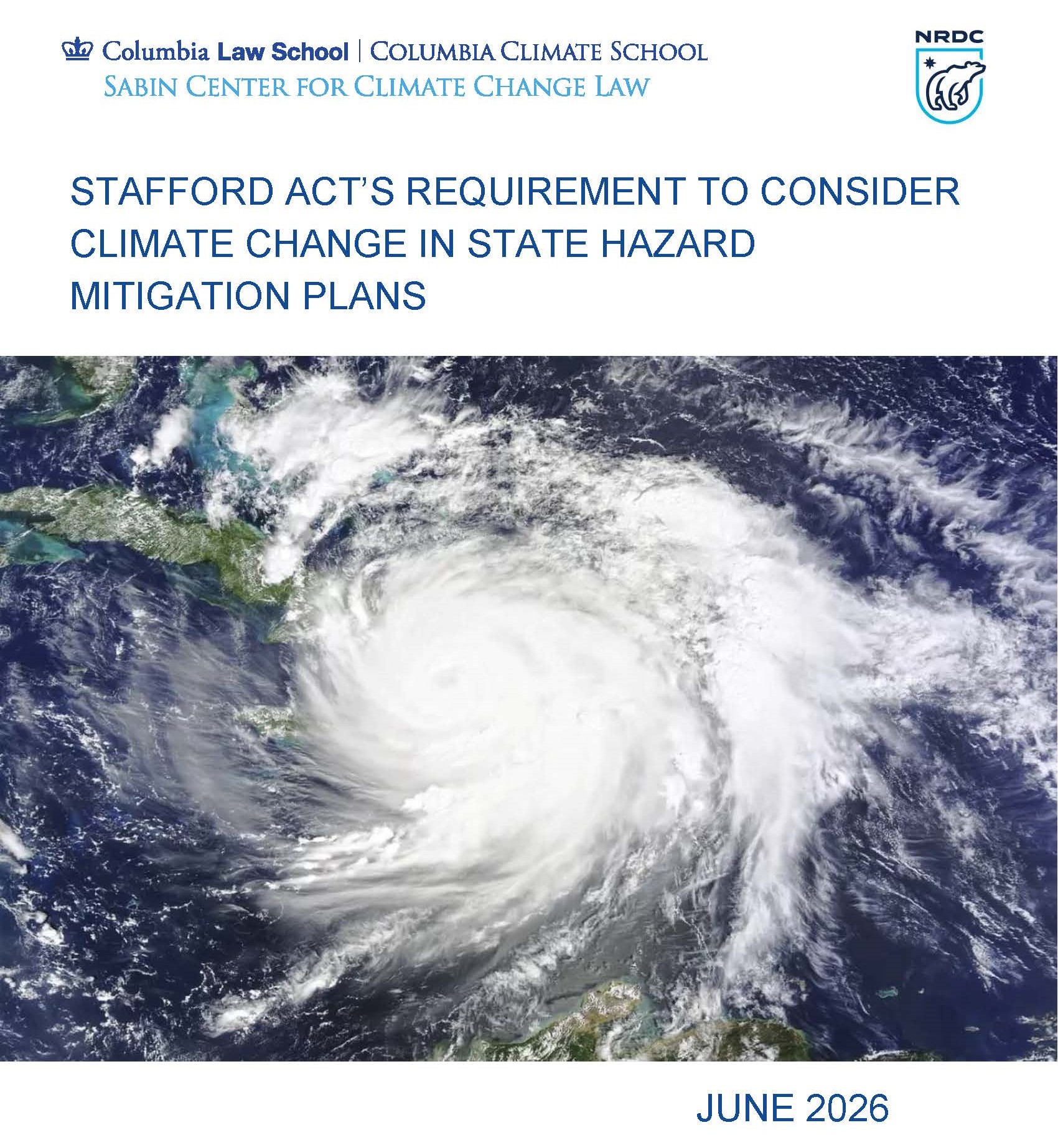
In a new white paper published by the Sabin Center and NRDC, we argue that state plans must consider the impacts of climate change on natural hazard risks and vulnerabilities under the Stafford Act.
The Stafford Act requires state hazard mitigation plans to “identify the natural hazards, risks, and vulnerabilities of areas in the State.” Under the statute and FEMA regulations, states must have FEMA-approved plans on file in order to receive hazard mitigation assistance. In the past, FEMA’s technical guide to state hazard mitigation planning expressly noted the need for state plans to account for the impacts of climate change on natural hazard risks and vulnerabilities. However, the most recent version of the guide, issued during President Trump’s second administration, scrubs all mention of climate change. Even so, 48 states address climate change in their state plans, recognizing the obvious relevance of climate change to hazard mitigation planning.
Regardless of FEMA’s retreat from the term “climate change” in its technical guide, the Stafford Act imposes a non-discretionary duty on FEMA to require consideration of climate change in state hazard mitigation plans. Under the Supreme Court decision in Loper Bright v. Raimondo, courts must determine the “best reading” of a statute to resolve ambiguity, using all available tools of statutory interpretation and without affording deference to an agency’s interpretation. In the white paper, we explain why the plain text, as well as the congressional findings and legislative history, demand that the Stafford Act be read to require consideration of climate change in state plans. For example, the paper highlights the overwhelming scientific evidence that climate change is increasing the frequency and intensity of natural hazards and, thus, community risks and vulnerabilities. The impact of climate change on hazard risks, therefore, falls within the plain meaning of the statutory language “natural hazards, risks, and vulnerabilities.” The Stafford Act’s congressional findings—which specifically reference “improving the climate and natural hazard resilience of vulnerable communities” (emphasis added)—lend further credence to this reading of the law.
Additionally, the white paper offers potential pathways to enforce this non-discretionary duty. First, a plaintiff could challenge FEMA’s failure to act on the duty to require consideration of climate change in state plans under the Administrative Procedures Act. Second, a plaintiff could challenge FEMA’s removal of references to climate change in its technical guidance as contrary to law and arbitrary and capricious under the Administrative Procedures Act. In both cases, the plaintiff would need to establish standing to sue; a full assessment of the prospects for establishing standing in such a suit are beyond the scope of the paper. Third, a party could petition for FEMA to initiate a rulemaking to add the requirement to its regulations on state plans. If FEMA were to deny the petition, the petitioner could challenge the denial in court.
Federal hazard mitigation assistance is a cornerstone of disaster preparedness in the United States. Effective planning has the potential to protect human lives and drastically reduce the cost of damage. But state hazard mitigation planning cannot reach its potential if it does not account for the full scope of hazard risks, as the Stafford Act requires. Failure to address climate change’s impacts on a state’s disaster risks and vulnerabilities is inconsistent with the text and purpose of the Stafford Act and has costly consequences. The best reading of the Stafford Act imposes a non-discretionary duty on FEMA to require state hazard mitigation plans to consider climate change. This reading will ensure that hazard mitigation assistance fulfils the objective of mitigating the damage caused by natural disasters, including those that are fueled by a changing climate.
Read more in the Sabin Center & NRDC’s new white paper here.