

Russia, Saudi Arabia and COP31 co-president Australia are the largest exporters of carbon dioxide (CO2) emissions in history, reveals Carbon Brief analysis.
Since 1850, the three nations – and other major fossil-fuel exporters – have exported hundreds of billions of tonnes of CO2 in the form of gas, oil and coal that has been burned in other countries.
Carbon Brief’s analysis of extraction-based CO2 emissions is based on figures compiled by Robbie Andrew, a senior researcher at Norwegian climate institute CICERO.
It shows that Australia is responsible for more than twice as much global warming when including emissions from its fossil-fuel exports, while Saudi Arabia has caused more than four times as much.
Australia has been under pressure for continuing to expand its fossil-fuel production ahead of the UN climate summit in Antalya, where it is co-president with host nation Turkey.

In contrast, nations that are heavily reliant on energy imports – such as Japan or Germany – have are responsible for far lower shares of planet-warming emissions, if responsibility passes to fossil-fuel producers.
There are many different ways to assign historical responsibility for current global warming.
Carbon Brief has previously published analysis based on territorial emissions, the consumption of imported goods, according to colonial rule or based on historical emissions per capita.
Historical responsibility
This year is expected to be around 1.5C hotter than pre-industrial temperatures. Next year is forecast to be the hottest on record, at around 1.7C of warming.
This year-to-year variation is due to natural variability, such as El Niño. However, approximately 100% of global warming to date is the result of human-caused greenhouse gas emissions.
The burning of fossil fuels since the industrial revolution is the largest contributor to this.
Since there is a direct link between each tonne of CO2 and each fraction of a degree of warming, historical fossil-fuel emissions can be tied to responsibility for current climate change.
This is typically calculated on the basis of historical territorial CO2 emissions, according to where in the world the fossil fuels are burned. It is also possible to assign historical responsibility on a “consumption” basis, according to where goods are used.
Historical emissions are often counted by country, but this puts the focus on populous nations. Alternatively, responsibility can be assigned per capita, based on today’s populations.
A less-familiar way to look at the question of historical responsibility is to consider where fossil fuels are extracted. This puts the spotlight on major fossil-fuel exporters.
The figure below shows that Russia, Saudi Arabia and Australia are the largest CO2 exporters of all time, based on emissions from exported fossil fuels since 1850.
(The allocation is based on extraction taking place within current national borders. Emissions under the former USSR, Czechoslovakia and Yugoslavia are allocated among constituent countries, based on their share of emissions at the time of separation.)
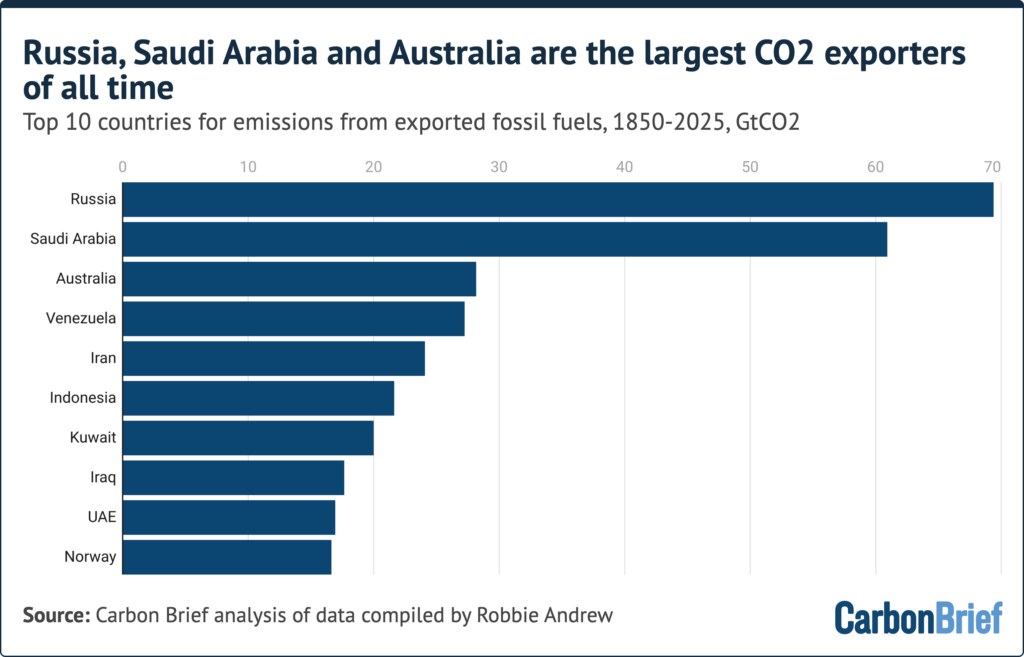
Other major CO2 exporters, based on their overseas sales of fossil fuels since 1850, include Venezuela, Iran, Norway, the United Arab Emirates and Canada.
Between them, these major coal, oil and gas producers have exported hundreds of billions of tonnes of CO2 over the past 175 years, according to Carbon Brief’s analysis.
Extraction-based accounting
The analysis shows that overall, the US and China retain the largest responsibility for historical warming under extraction-based accounting, despite having been net CO2 importers since 1850.
The US has large resources of coal, oil and gas, but was nevertheless a major oil importer until after the shale revolution in the early 2000s.
China remains a major oil and gas importer, describing itself as “rich in coal, lacking oil and gas”.
Russia remains in third place, as shown in the figure below, despite gaining responsibility for an extra 69bn tonnes of CO2 from exported fossil fuels.
The UK becomes the fourth-largest historical emitter, climbing above Germany due to the latter’s reliance on fossil-fuel imports.
Saudi Arabia becomes responsible for the world’s fifth-largest share of historical warming when including its fossil-fuel exports, which increase its cumulative emissions more than fourfold.
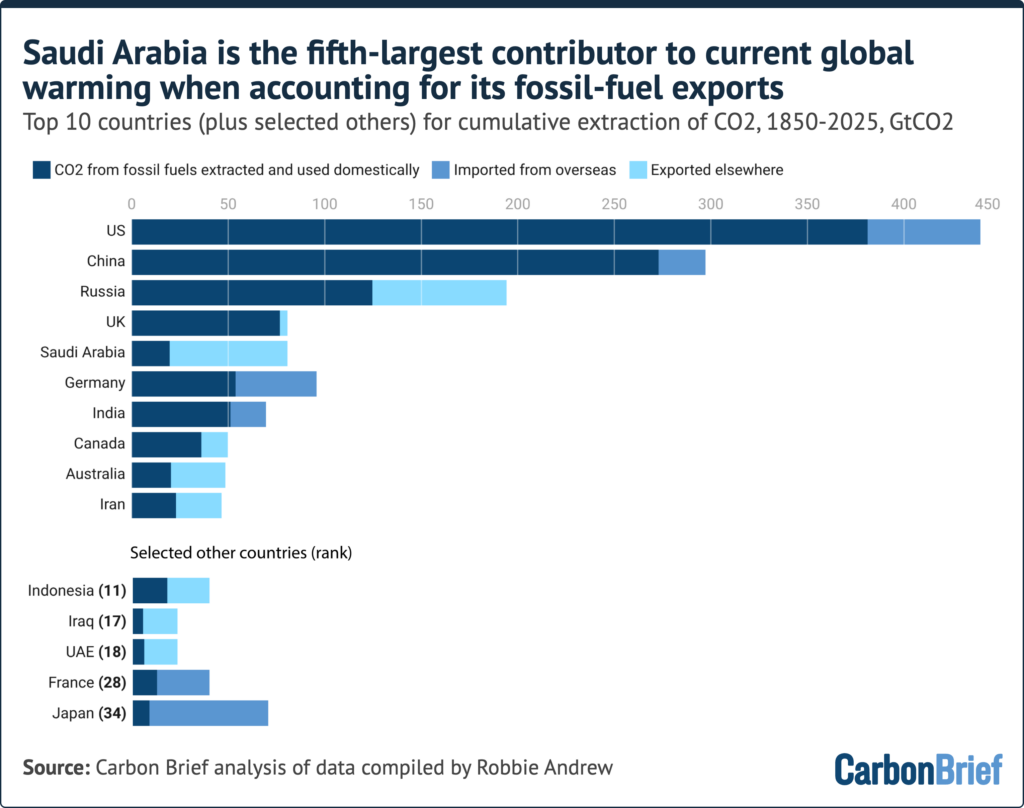
Australia also climbs up the rankings, becoming one of the top-ten largest emitters when including its fossil-fuel exports. This more than doubles its share of historical emissions.
Nations that drop down the rankings under extraction-based accounting, due to their reliance on fossil-fuel imports, include Germany, India, France and COP31 host Turkey.
Japan is a particularly notable example, as it is almost completely reliant on fossil-fuel imports. The nation is the sixth-largest emitter on a territorial basis and the 34th-largest on an extraction basis.
Per-capita accounting
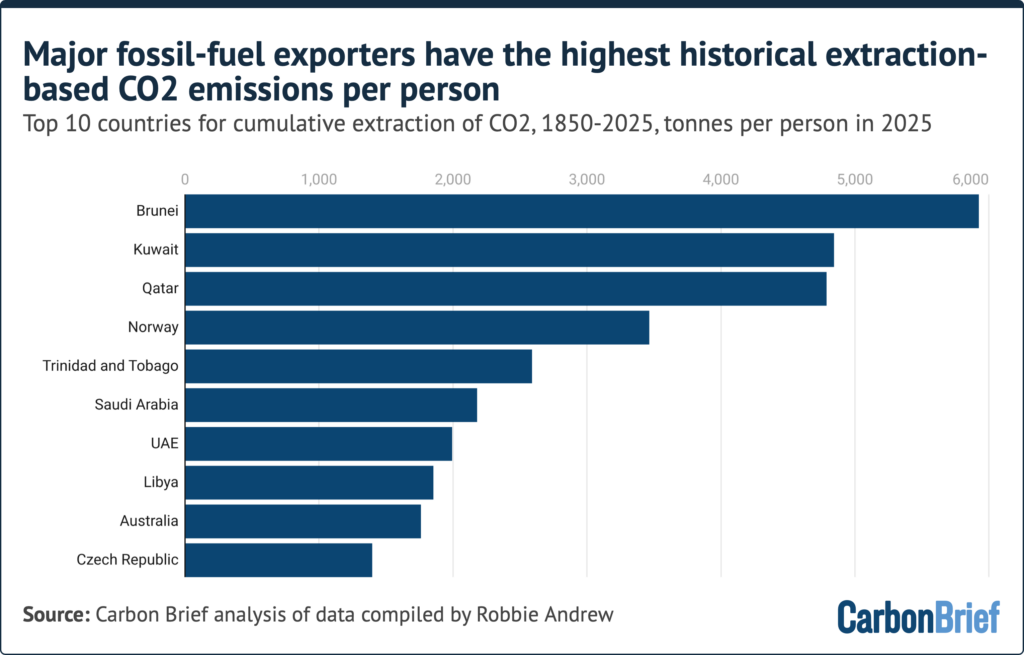
When considering population sizes, major fossil-fuel exporters have the highest extraction-based CO2 emissions since 1850, as shown in the figure below.
Small nations that export large amounts of oil and gas are particularly prominent on this list, including Brunei, Kuwait, Qatar, Norway and Trinidad and Tobago.
Andrew tells Carbon Brief that while the extraction-based accounting offers an alternative perspective on historical responsibility for warming, it also raises complex questions. He explains:
“At the end of the day, it’s not solely the responsibility of extracting countries that fuels are combusted; it’s joint responsibility between extractors, producers and consumers.”
He adds that responsibility for past decisions is shared by many actors. For example, he notes that oil production in the Middle East was historically “developed by and for western powers”.
Free weekly newsletter

About the data
National emissions under extraction-based accounting come from a dataset developed by Robbie Andrew and covering the period from 1850-2025.
Emissions are allocated to the country that extracted the relevant fossil fuels, regardless of where the coal, oil or gas was burned.
The allocation is based on current national borders. Emissions that took place within the former USSR, Czechoslovakia and Yugoslavia are allocated among their present-day constituent countries, based on the relative shares of emissions at the time of separation.
Andrew notes that the dataset is a draft release, based on available data.
Population data for 2025 is taken from the UN Population Fund.



The post Revealed: Russia, Saudi Arabia and Australia are largest CO2 exporters of all time appeared first on Carbon Brief.