
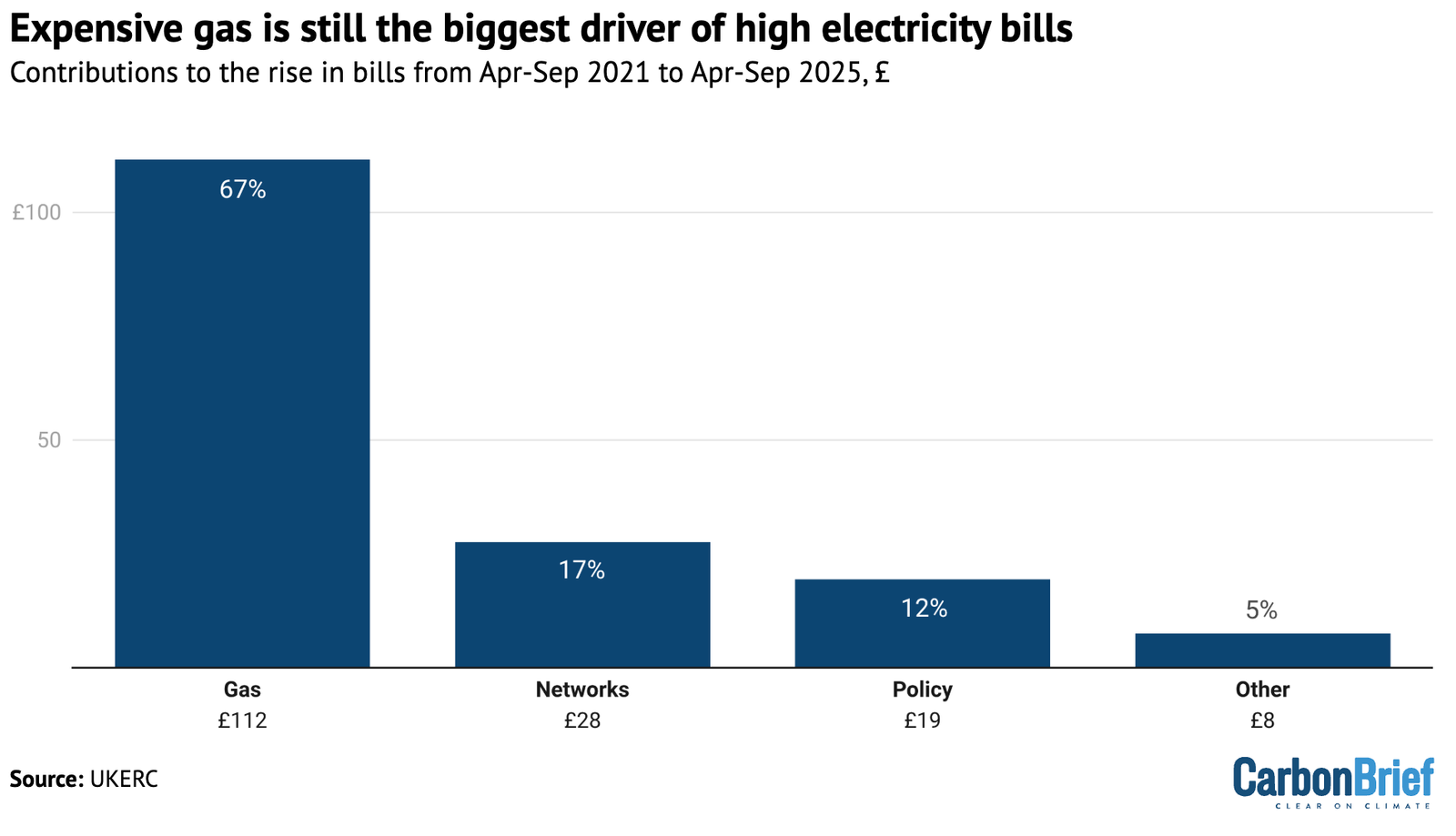
High gas prices are responsible for two-thirds of the rise in household electricity bills since before the global energy crisis, says the UK Energy Research Centre (UKERC).
The new analysis, from one of the UK’s foremost research bodies on energy, flatly contradicts widespread media and political narratives that misleadingly seek to blame climate policies for high bills.
Kaylen Camacho McKluskey, research assistant at UKERC, tells Carbon Brief that despite “misleading claims” about policy costs, gas prices are the main driver of high bills. She says:
“While the story of what has driven up GB consumer electricity bills is often largely attributed to policy costs, our analysis shows that this is not the case. Volatile, gas-linked market prices – not green policies, as some misleading claims have suggested – dominate the real-terms increase in bills since 2021.”
In its 2025 review of UK energy policy, published today, UKERC says that annual electricity bills for typical households have risen by £166 since 2021.
It says that, after adjusting for inflation, some two-thirds of this increase (£112) is due to higher wholesale gas prices, as shown in the figure below.
(This analysis does not account for the recent surge in wholesale gas prices, which, in a matter of days, have jumped by around 40% in the UK and 140% in the US.)

UKERC estimates that, despite only supplying a third of the country’s electricity, gas-fired generators set the wholesale price of power around 90% of the time in 2025.
(This is slightly lower than widely cited earlier estimates, published in 2023 and covering 2021, which found gas was setting power prices 97% of the time.)
A surge of new clean power means that gas would only set wholesale power prices 60% of the time by 2029, UKERC says, adding that this would cut the nation’s exposure to “gas price shocks”.
It finds that new renewable projects set to come online over the next three years could cut wholesale power prices by 8% from current levels.
UKERC argues that the government could “strengthen…these downward trends” by shifting older renewable plants onto fixed-price “contracts for difference” (CfDs).
These older schemes, built under a policy known as the “renewables obligation”, are paid a top-up subsidy in addition to the wholesale power price, linking their receipts to high gas prices.
Newer renewable projects with CfDs get a fixed price, which is not linked to wholesale electricity prices or the price of gas power that drives it.
Prof Rob Gross, UKERC director says in a press release that “unpredictable global gas prices still dominate our power market”. He continues:
“The link between the wholesale price of gas and electricity prices continues to be the most significant factor in the price increases consumers have seen over the last few years. Government took action on some policy costs in [last year’s] budget and ongoing policies will weaken the link to gas prices. But more could be done to help ensure that the stable prices offered by renewables flow through to consumer bills.”
The UKERC analysis shows that rising network charges, linked to investments in expanding the electricity grid as well as balancing supply and demand in real time, were the second-largest contributor to the rise in bills since 2021.
Significant further grid investments are set to add further pressure on bills over the next few years. However, energy regulator Ofgem says these investments will cut bills relative to the alternative.
Policy costs are only the third-largest driver of current high bills, according to UKERC’s analysis. It says these were linked to just 12% of the rise for typical households, or £19 per year.
It is commonly argued that rising policy costs are certain to raise bills, but this tends to ignore the interplay between CfDs and wholesale power prices.
The record-breaking recent government auction for CfDs is expected to be roughly “cost neutral” for bills, potentially even generating consumer savings of £1bn a year by 2035.
As UKERC explains, this is because new renewable projects will receive CfD payments and may result in higher network costs, but they also cut wholesale power prices. A full analysis of the overall impact on bills must take all of these factors into account.
The UKERC report aligns with another recent analysis from thinktank Nesta, which said that, while there was a pressing need to look at future cost pressures from network and policy charges, “it is clear that gas is still the main source of our high energy bills to date”. It added:
“It is still true that higher gas prices are the main reason for higher energy bills for most British households when you look at the whole bill. Gas is not the only culprit, but it is still the biggest one.”




The post Expensive gas still biggest driver of high UK electricity bills, says UKERC appeared first on Carbon Brief.