
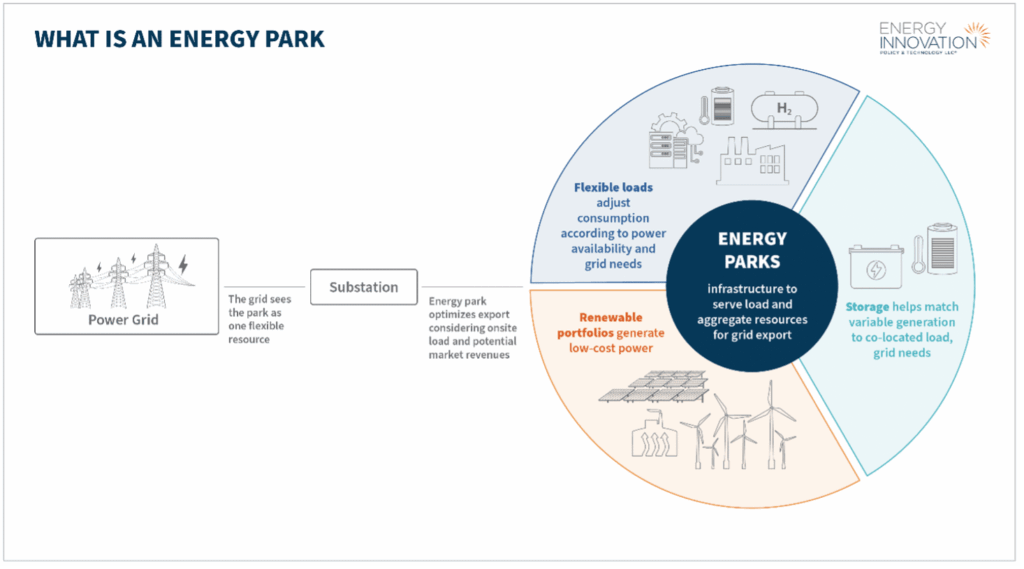
An energy park is an affordable, quick solution to meet rising energy demand, particularly a clean energy park. This type of energy park pairs various clean energy generation sources like solar or wind, paired with energy storage solutions like batteries, all developed alongside electricity consumers like factories or data centers.
Bundling diverse energy generation with storage to in proximity to large, flexible loads ensures cheaper and more reliable access to clean electricity output, while avoiding grid connection or development barriers to help meet rising power demands.
Energy parks are connected to the grid at one location, or in the same general area, so they can power themselves during normal operations or provide power to the larger grid during high demand, creating a grid asset instead of a grid liability.
Energy parks can also replace inflexible, large, single-source power plants with a “speed-to-power” solution that solves problems for grid operators by quickly meeting large new sources of demand without cutting into power supply for the host grid or requiring big new upgrades to the grid.

Are energy parks clean?
Energy parks can theoretically be powered by any generation source, including fossil fuels, but doing so exposes customers to higher price risks than clean energy. While natural gas prices have fallen in recent years due to America’s fracking boom, it is a commodity traded on global markets subject to price spikes whenever wars or extreme weather reduce supplies – for instance the Iran war raised gas costs almost overnight, which threatens America’s industrial sector. Coal has been proposed as another way to meet rising demand, but the cost of generating power at existing coal plants in the United States has risen faster than inflation due to a combination of aging power fleets and increased fossil fuel prices – making them incredibly uncompetitive.[1] Aging plants means coal is also increasingly unreliable.[2]
Renewable energy makes clean energy parks modular, meaning that they are well-suited to come online quickly. A combination of renewable generation sources, such as wind, solar, geothermal, and hydropower, plus battery storage or industrial technologies like thermal batteries, offers consumers variety and reliability. In addition to cutting air pollution, renewable energy is the quickest and cheapest way to expand generation capacity.[3] In 2025, batteries and renewables composed more than 90 percent[4] of all new generation capacity added to the U.S. grid.
Pairing clean energy and battery storage can reduce greenhouse gas emissions and increase productivity. Google, for example, recently announced plans to invest $20 billion[5] in clean energy parks over the next five years, and just announced it would power a new data center[6] with a massive battery storage facility.
Energy parks create good economic benefits
Cutting costs is a big part of what makes behind-the-meter or on-site energy generation so alluring. By co-locating large energy customers alongside clean energy generation, consumer can reduce infrastructure expenses, tap all available tax credits, and optimize their generation and storage capacity.
Sourcing electricity from renewable projects is the cheapest and quickest way to generate power. The cost of wind, solar, and battery storage has declined significantly in the past decade. The International Renewable Energy Agency recently reported “renewables maintained their price advantage over fossil fuels, with cost declines driven by technological innovation, competitive supply chains, and economies of scale.”[7]
Building behind-the-meter power in proximity to large energy demand is important because generating power closer to the consumer helps avoid transmission and distribution costs, which vary depending on local utilities. It also can avoid grid interconnection queues, which can take years to resolve, and reduces the need to build new transmission lines. And it unlocks the potential for energy parks to store excess energy when production exceeds demand or sell it to the larger grid when demand is highest.
Modular design is one of the best aspects of energy parks
Modularity is a defining feature of a clean energy park – and one of its greatest strengths. New capacity to generate, store and use electricity can be added over time as new demand comes online, meaning the entire energy park project doesn’t need to occur all at once.
This gives stakeholders the opportunity to thoughtfully develop their facilities and raise the necessary capital, removing some risks associated with bringing new projects online. It also acts as a built-in safety net that can shield developers from changing market factors.
Modular design is flexible, meaning each energy park can be customized to meet the unique needs of the industries and consumers it serves. As projects evolve, they can grow with technology innovations or shifting economic realities, for example adding thermal batteries[8] if the energy park has high-heat manufacturing needs.

Transitioning Colorado’s Comanche 3 coal plant into a clean energy park
Pueblo, Colorado’s Comanche 3 coal plant, is an ideal example of how a clean energy park can cut costs and create new economic opportunities. Comanche 3 is set to retire in 2031, and a just transition process involving state officials, the utility Xcel Energy, and local community leaders is considering replacing it with a clean energy park.[9] Doing so could diversify the region’s economy while increasing grid resiliency and cutting toxic air pollution.
Flexible and modular design allows for bespoke development. Local Pueblo industries such as steel and cement manufacturing require high heat. Transitioning the coal plant into an energy park creates opportunities to deploy industrial thermal batteries which store electricity as heat which can be used directly in industrial processes that requires hot air or steam.
Modeling with a sample portfolio of resources shows an energy park powered by wind and solar generation paired with onsite batteries could begin construction years before other potential generation sources, would generate property tax payments that peak at $40 million annually, and create hundreds of permanent jobs in engineering, business operations, and industrial plant operation.
A cleaner, cheaper, more reliable future with energy parks
Demand for electricity, as well as the cost of generating it, has risen drastically as data centers come online, and the grid begins to age.
Clean energy parks make industrial facilities considerate neighbors, since they serve the primary function of plugging an energy hole without overburdening the communities that house these facilities. Meanwhile, adding energy sources keep the air and water clean for nearby communities, and electrifying industry with clean energy increases efficiency and cut costs.
They also accelerate project development and economy growth, without saddling the community with higher utility bills. Consumers, utilities and companies are always looking for the newest, cheapest and more secure technological solutions–as far as reliable, secure and cheap energy goes, energy parks are a safe future-facing solution.
[1] Michelle Solomon, “Coal Power 28 Percent More Expensive In 2024 Than In 2021,” Energy Innovation, (2025): https://energyinnovation.org/report/coal-power-28-percent-more-expensive-in-2024-than-in-2021/
[2] Matthew Zeitlin, “Trump Wants To Prop Up Coal Plants. They Keep Breaking Down.,” Heatmap, (2025): https://heatmap.news/energy/coal-reliability
[3] Energy Innovation, “What Is Clean Energy,” Energy Innovation, (2024): https://energyinnovation.org/expert-voice/what-is-clean-energy/
[4] Energy Innovation, “What Is Clean Energy,” Energy Innovation, (2024): https://energyinnovation.org/expert-voice/what-is-clean-energy/
[5] Maeve Allsup, “Google’s Intersect Deal Is Much More Than A Green Power Play,” Latitude Media, (2026): https://www.latitudemedia.com/news/googles-intersect-deal-is-much-more-than-a-green-power-play/
[6] Lisa Martine Jenkins, “With Form Energy Deal, Google’s Clean Transition Tariff Is Growing Up,” Latitude Media, (2026):https://www.latitudemedia.com/news/with-form-energy-deal-googles-clean-transition-tariff-is-growing-up/
[7] International Renewable Energy Agency, “Renewable Power Generation Costs In 2024,” International Renewable Energy Agency, (2024): https://www.irena.org/Publications/2025/Jun/Renewable-Power-Generation-Costs-in-2024
[8] Jeffrey Rissman and Eric Gimon, “Thermal Batteries: Decarbonizing U.S. Industry While Supporting A High-Renewables Grid,” Energy Innovation, (2023): https://energyinnovation.org/report/thermal-batteries-decarbonizing-u-s-industry-while-supporting-a-high-renewables-grid/
[9] Michelle Solomon and Eric Gimon, “Flexible, Clean Industry And Sustainable Energy Power Strong Economies: A Case Study In Pueblo, Colorado,” Energy Innovation, (2025): https://energyinnovation.org/report/flexible-clean-industry-and-sustainable-energy-power-strong-economies-a-case-study-in-pueblo-colorado/
The post What Is An Energy Park? appeared first on Energy Innovation.