
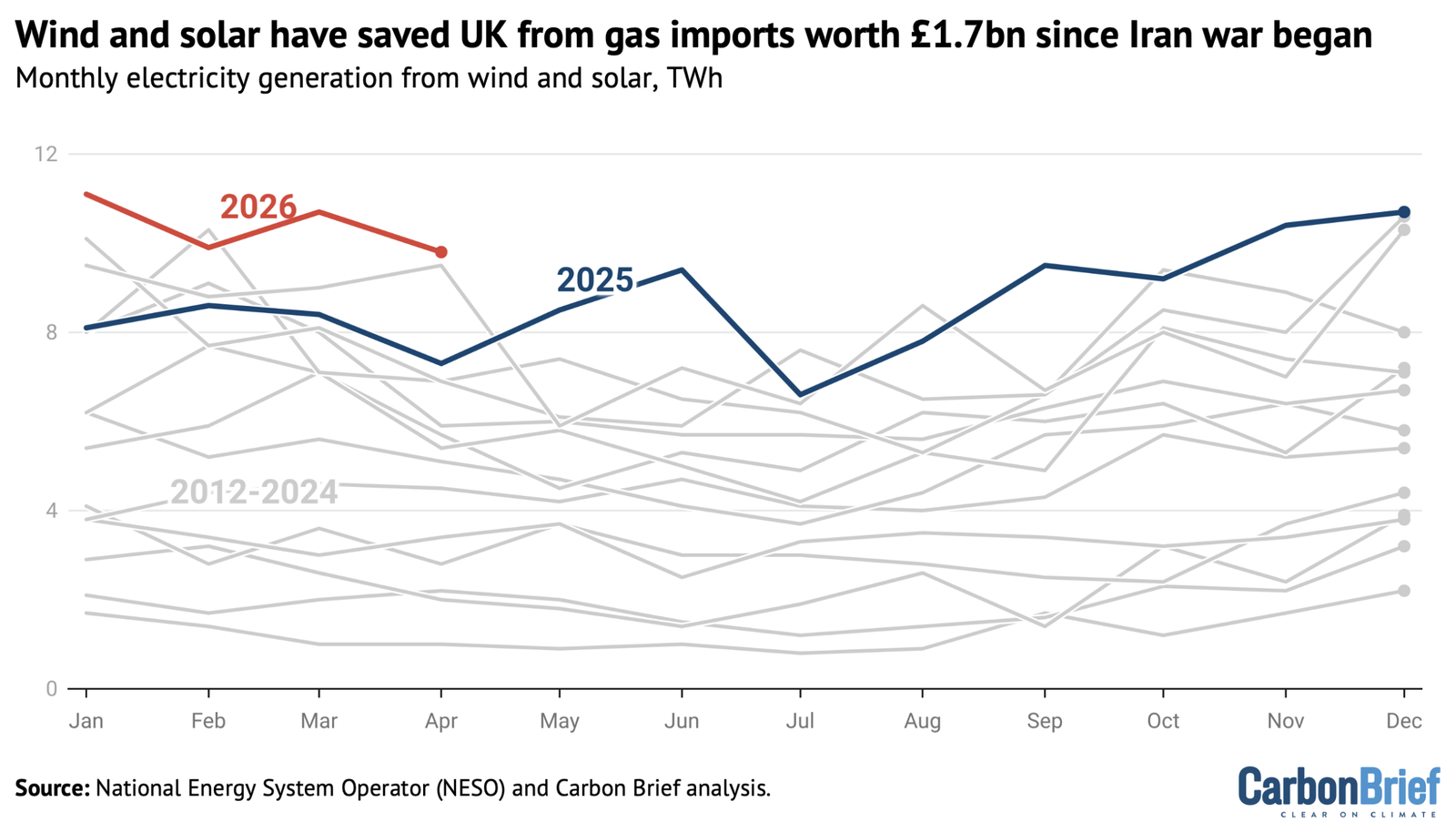
The UK has avoided the need for gas imports worth £1.7bn since the start of the Iran war, as a result of record electricity generation from wind and solar, reveals Carbon Brief analysis.
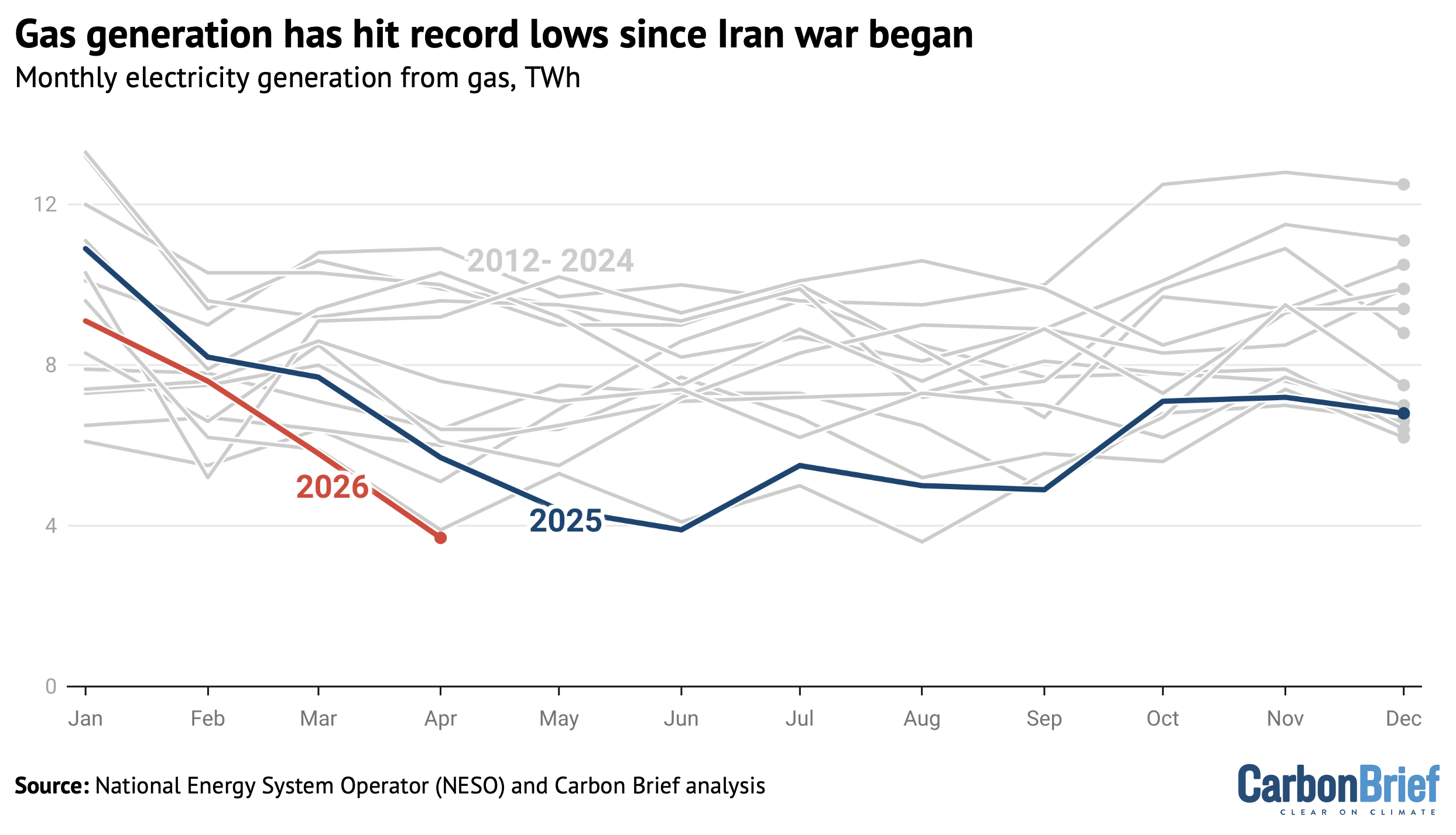
The surge in wind and solar output is cutting the need for gas-fired generation, which has been nearly a third lower than last year and fell to record lows in both March and April 2026.
The figure below shows that wind and solar have generated a record 21 terawatt hours (TWh) on the island of Great Britain since the end of February 2026, when the US and Israel first attacked Iran.
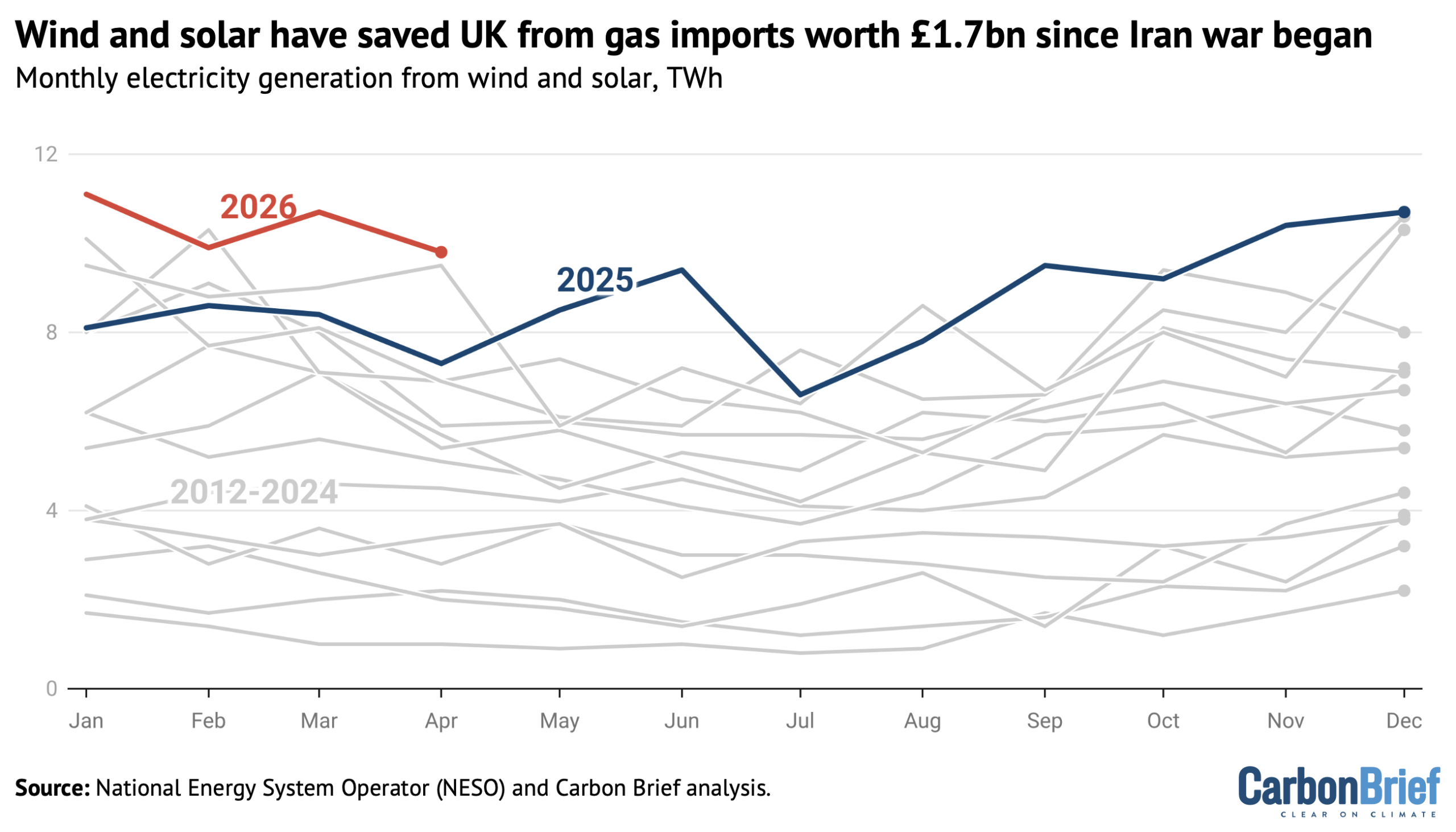
Amid another fossil-fuel price crisis, the record wind and solar output since the start of the Iran war avoided the need to import 41TWh of gas – roughly 34 tankers of liquified natural gas (LNG).
Importing those 34 tankers of LNG would have cost around £1.7bn, given the high gas prices triggered by the conflict.
At the same time, record wind and solar helped to cut electricity generation from gas by around a third year-on-year to the lowest levels ever recorded for the months of March and April, as shown in the figure below.
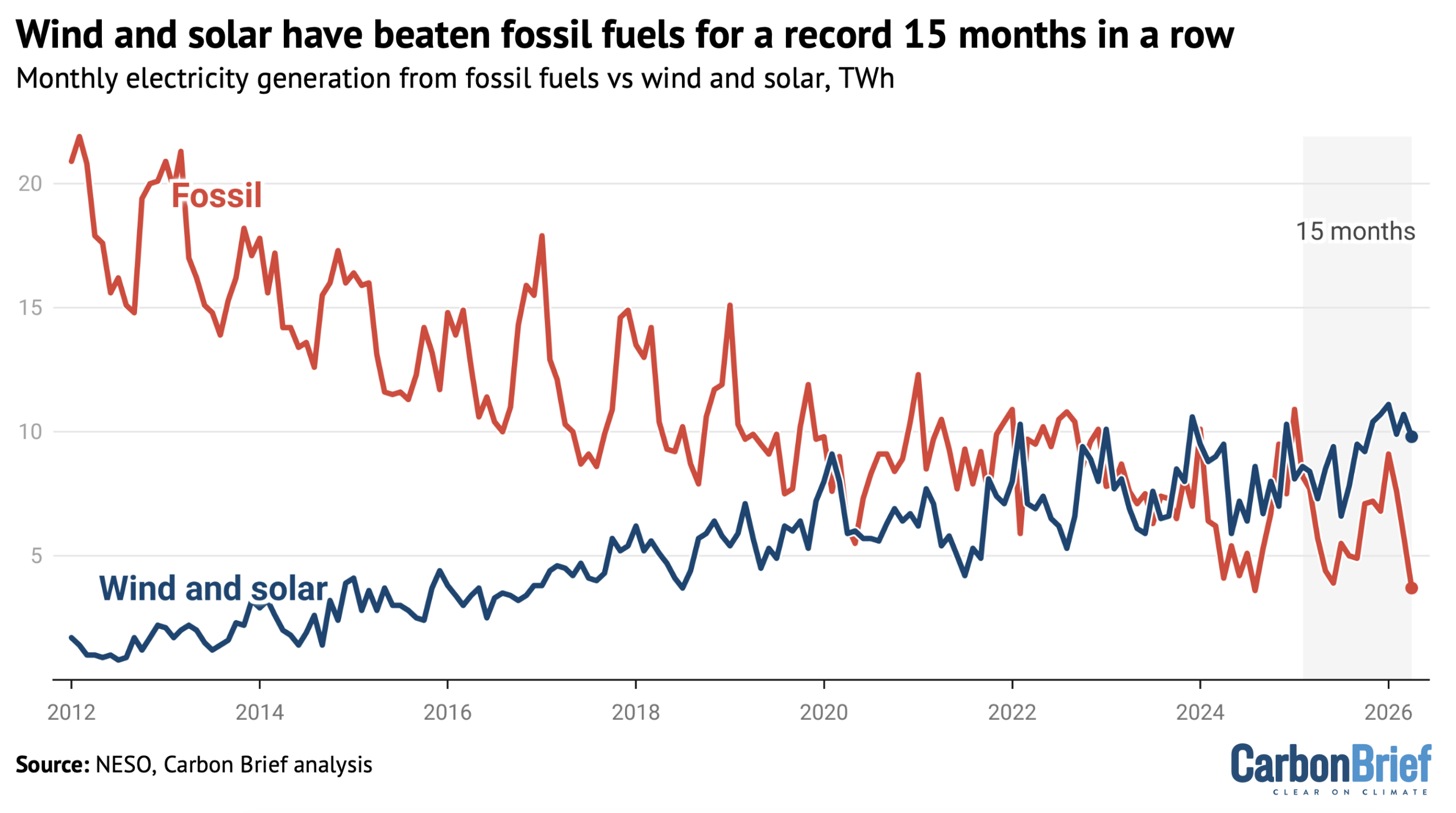
Together, wind and solar have generated more than twice as much electricity as fossil fuels over the period since the Iran war began. The country’s electricity mix has now flipped: a decade ago, fossil fuels were generating more than four times as much electricity as wind and solar.
Indeed, wind and solar have generated more electricity than fossil fuels for a record 15 months in a row. As shown in the figure below, this included a full winter season for the first time in 2025-26.
This meant that gas was setting the price of electricity roughly 25% less often in both March 2026 and April 2026 than in the same month in 2022, when fossil-fuel prices spiked after Russia’s invasion of Ukraine.
April 2026 also marked a series of other records for the GB electricity system.
For half an hour between 15.30 and 16:00 on 22 April, a record 98.8% of the electricity feeding into the country’s main “transmission” grid came from zero-carbon sources, according to the National Energy System Operator (NESO).
In addition, solar generation hit a series of new record-highs, ultimately reaching 15.4 gigawatts (GW) on the afternoon of 23 April. Wind set a new record of 23.9GW on 25 March.



The post Analysis: Wind and solar have saved UK from gas imports worth £1.7bn since Iran war began appeared first on Carbon Brief.