

Welcome to Carbon Brief’s China Briefing.
China Briefing handpicks and explains the most important climate and energy stories from China over the past fortnight. Subscribe for free here.
Key developments
New documents ramp up pressure on coal
‘STRICTLY CONTROL’ FOSSIL FUELS: On 22 April, China issued a set of “guiding opinions” on energy conservation and carbon reduction that urged local governments to “strictly control fossil-fuel consumption”, according to the text published by state news agency Xinhua. Hu Min, director and co-founder of the the Beijing-based Institute for Global Decarbonization Progress, said in comments to Carbon Brief that the document was a clear signal of China’s political leaders’ desire to reduce the country’s coal usage and a “way to move things forward” until more specific policies are published. Government officials noted that the opinions are of “great significance for building broader and stronger consensus across society”, reported information platform Tanpaifang.
INCREASED OVERSIGHT: The next day, the government announced new evaluation criteria for judging provinces on their efforts to meet China’s climate goals, including on raising “clean-energy consumption” and limiting “use of coal and oil”, reported Bloomberg. The 14 indicators underscore China’s “key priorities” and encourage broader carbon reduction efforts, said energy news outlet China Energy Net. They build on China’s existing inspection system to create a “much stronger accountability and compliance system”, Qin Qi, China analyst at the Centre for Research on Energy and Clean Air, told Carbon Brief. For more detail see Carbon Brief’s Q&A on what the two policies mean for China’s energy transition.
‘RARE’ SIGNAL: Both documents were issued by the highest levels of the nation’s political system, which is “extremely rare” and “reflects the strategic importance” of China’s climate goals, Wu Hongjie, deputy secretary-general of the China Carbon Neutrality 50 Forum, told Jiemian News. In a comment article for finance news outlet Caixin, Chen Lihao – a member of the Jiusan Society, environment minister Huang’s political party – said the two documents “form the institutional foundation” for China’s “full-scale transition” to a “dual control of carbon” system.
Downpours in south China
‘RECORD-BREAKING’ RAIN: Heavy rainfall is hitting central and southern China, with Hunan, Guizhou and Jiangxi provinces reporting record-breaking levels of precipitation last week, reported the Communist party-affiliated People’s Daily. It added that the government is ramping up “flood control” measures in response. On 26-27 April, one part of Guangxi province received as much as 14cm of rain per hour, reported the state-supporting newspaper Global Times. Meanwhile, Chinese vice-premier Liu Guozhong met with the World Meteorological Organization secretary-general Celeste Saulo to discuss cooperation on global “meteorological governance”, said state news agency Xinhua, with the discussion touching on early warning systems and disaster relief.

EL NIÑO RISK: Officials at China’s National Climate Center (NCC) have said that an El Niño weather pattern is “likely to set in around May” and “intensify during the summer and autumn”, said China Daily. The state-run newspaper also quoted NCC chief forecaster Chen Lijuan saying it was “premature” to conclude that the El Niño could be at its strongest in 140 years, or that it could lead to record-breaking heat, although he added that the risks of such weather are “clearly increasing”. Wang Yaqi, a senior engineer at NCC, noted that the phenomenon “could hit hydropower-dependent regions hard, pushing them to burn more fossil fuels”, according to the Hong Kong-based South China Morning Post.
Solar capacity growth slows
CLEAN CAPACITY: China’s clean-energy grid capacity now exceeds 2,400 gigawatts (GW), as of March 2026, or 60% of the total power mix, said state broadcaster CGTN in coverage of comments from energy officials at a press conference. It added that, within this, total wind and solar capacity reached 1,900GW. Energy news outlet International Energy Net cited the officials saying that China’s operational capacity for “green hydrogen” stands at 250,000 tonnes, with another 900,000 tonnes under construction.
SOLAR SLOWS: However, a data release showed that China added 41GW of new solar capacity in the first three months of 2026, reported BJX News, down from 60GW of new capacity in January-March 2025. Bloomberg noted that new solar capacity additions “slowed sharply to hit a four-year low” in March, adding that wind and thermal capacity growth also both slowed.
-
Sign up to Carbon Brief’s free “China Briefing” email newsletter. All you need to know about the latest developments relating to China and climate change. Sent to your inbox every Thursday.
‘MOST AMBITIOUS GOAL’: In a separate press conference, Chinese officials confirmed to Bloomberg that a pledge in the 15th five-year plan to double “non-fossil energy” in 10 years referred to energy capacity – not generation or consumption – and would run from 2025-2035. These details were “unclear” in the five-year plan itself, the outlet added. The economic news outlet Economic Daily said that the doubling goal was “one of the most ambitious goals in China’s energy transition history”, adding that “accelerating” the energy transition would allow the country to both reduce its reliance on the international energy market and “seize the high ground in the global race” to develop low-carbon industries.
More China news
- NEW BLEND: China has begun a project to blend gas supplies with 10% hydrogen in a part of Shandong province, reported the South China Morning Post, which added that the shift could cut China’s annual carbon emissions by “roughly 30m tonnes”.
- SKY-HIGH: China launched a “high-precision” satellite to monitor greenhouse gas emissions, said Xinhua.
- SUNNY SPAIN: Chinese automaker SAIC plans to build an electric vehicle (EV) factory in Spain, reported Bloomberg.
- MING YANG: Bloomberg also said that wind turbine maker Ming Yang is considering Spain after plans for a factory in the UK were blocked.
- FORMAL COMPLAINT: China has “formally submitted a complaint” to the EU about its Industrial Accelerator Act, said China Daily.
- EU TARIFFS: China’s commerce minister said he reached a “soft landing” with EU officials on EU tariffs on imports of Chinese-made EVs, according to Reuters.
Spotlight
How war, silver and taxes propelled China’s cleantech exports
China’s export of clean-energy technologies surged in March, driven by a doubling in solar shipments, according to analysis by Carbon Brief of Chinese customs data.
The spike can be explained in part by the impact of the conflict in the Middle East, but analysts argue that a newly enacted solar export policy is also behind the figures.
In this issue, Carbon Brief explores the factors behind the export spike and whether or not it will be sustained.
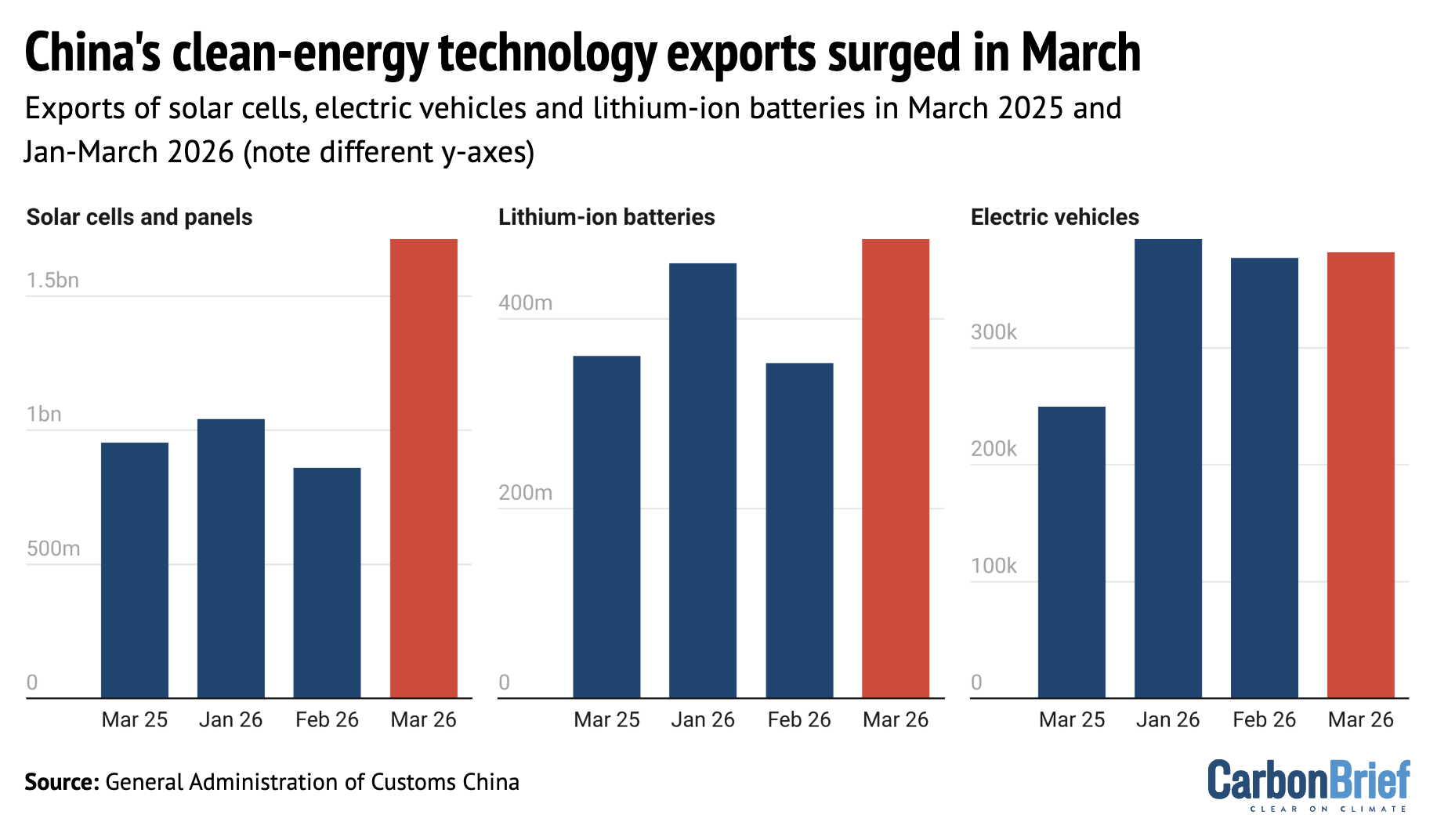
China’s exports of the “new three” clean-energy technology surged by 70% year-on-year in March 2026, reaching $21.6bn, according to Carbon Brief analysis.
Exports of the three technologies – solar cells and panels, electric vehicles (EVs) and lithium-ion batteries – were also up 37% from February, the month before the Iran war.
The conflict in the Middle East is one explanation for the surge, as it has caused several countries to emphasise the need to increase non-fossil energy supplies.
However, there are also other important drivers, revealed by Carbon Brief analysis of customs data showing differences in exports between solar, EVs and batteries.
Solar exports were notably higher in March 2026 than in the previous two months, jumping 99.2% compared to February.
By contrast, neither batteries’ nor EVs’ March figures came close to the surge in solar cells.
China’s March exports of batteries rose 37% compared with the previous month, while month-on-month EV shipments increased just 1.4%.
(Figures from the China Passenger Car Association suggest a larger rise in percentage terms, but this is based on a narrower scope that does not capture all exports.)
This may be because both technologies saw strong export performance throughout the first quarter of 2026. According to the customs data, more than one million EVs were exported from China between January and March, up 73% compared with the same period last year.
These quarterly exports may have helped meet growing interest in EVs due to the conflict, with BloombergNEF estimating that sales of EVs rose to 1.1m – up 2% year-on-year – in March. (Bloomberg said, within this total, sales “cooled” in China and the US but “surged” in Europe and parts of Asia.)
Solar surge
The chart below shows the export volumes of solar cells, EVs and batteries in March 2025, plus the first three months of 2026.
March’s solar exports were capable of generating 68 gigawatts (GW), equivalent to Spain’s entire installed solar capacity, according to energy thinktank Ember.
The Ember analysis showed that 50 countries set all-time records for Chinese solar imports in March, with another 60 reaching their highest levels in six months.
Exports to Asia doubled to 39GW, while shipments to Africa surged 176% to 10GW. Combined, these two regions accounted for three-quarters of the overall increase in exports.
The Middle East conflict has boosted demand, but a domestic policy deadline was a more immediate driver, analysts told Carbon Brief.
The Chinese government removed export tax rebates for solar products on 1 April, prompting manufacturers to rush out shipments before the change took effect.
Qin Qi, China analyst at the Centre for Research on Energy and Clean Air, told Carbon Brief that such policy deadlines “can create a very sharp one-month jump in shipments”.
Batteries and EVs currently continue to receive export rebates.
Falling silver prices are another potential factor, as silver paste is used to make a key component in solar panels. The reversal of a recent price rally that had raised costs helped manufacturers make more panels ahead of the export switch, Marius Mordal Bakke, head of solar research at consultancy Rystad Energy told Reuters.
Temporary spike
Analysts predict that China’s April solar exports are unlikely to repeat March’s surge. Moreover, February exports were depressed by the Chinese New Year public holiday, making the March comparison unusually unfavourable.
“A month-on-month drop in April would not be surprising,” said Qin.
But she remains optimistic that global solar capacity additions outside China will continue to grow in 2026 due to energy supply concerns sparked by the Middle East conflict.
Dave Jones, chief analyst at Ember, said the removal of the export rebate will not “dramatically change demand”, especially as the conflict continues.
He argued that the policy could be positive, telling Carbon Brief: “This is what the global market needs: a more level playing field with China.”
This spotlight is by freelance China analyst Lekai Liu for Carbon Brief.
Watch, read, listen
TARGET ‘DIFFICULTIES’: Two researchers at the Energy Research Institute, a state thinktank, wrote in Economic Daily that China faces several “difficulties” in meeting its new carbon-intensity targets, including already-high renewable capacity installations and high levels of energy efficiency.
COMPARE AND CONTRAST: The US-China Podcast interviewed Prof Alex Wang on China’s approach to environmentalism and his view on the country’s energy transition.
GOVERNMENT CALLOUT: State broadcaster CCTV published a segment critiquing the massive investments and special treatment that local governments gave to their EV industries, fuelling intense competition.
‘THIN ARGUMENT’: A comment in Lawfare argued that the US should focus more on the “genuine geopolitical risks of climate change and [geoengineering] development”, rather than “thin” arguments around China weaponising weather modification technologies.
22.6%
The rate of “environmental health literacy” – or “recognition of the value of the ecological environment and its impact on health” – among China’s citizens, according to a government survey covered by Xinhua.
New science
- China will need to build more pipelines and push its carbon price above $100/tonne to make “green” ammonia a cost-competitive option for marine fuel | One Earth
- Carbon dioxide (CO2) emissions from China’s lakes increased from 41m tonnes to 51m tonnes of CO2 per year between 2000 and 2021, coinciding with “rapid lake expansion” across the country | Science Advances
Recently published on WeChat
China Briefing is written by Anika Patel, with contributions from Lekai Liu, and edited by Simon Evans. Please send tips and feedback to china@carbonbrief.org

The post China Briefing 30 April 2026: Fossil fuel ‘strict controls’ | El Niño approaches | Why cleantech exports have surged appeared first on Carbon Brief.