

The lithium-ion batteries powering tools on renewable energy sites deserve the same attention to safety as the larger systems being installed and maintained, argues Matthew Partridge of Armorgard UK.
Battery storage projects are designed around thermal management and a fire strategy. Matthew Partridge argues that the tool batteries used to build and maintain them need the same engineering mindset, starting with how the people using them charge and store them day to day.
The environmental technology sector designs heat management into every battery system it builds. Long before a storage project goes ahead, the team works out how the cells will be kept cool, how gas will be detected, how far apart the units sit and what happens if a fire breaks out. Then, before anything arrives on site, that planning is checked for any gaps.
The cordless tools that are used to build and maintain that project get far less attention. Usually, they turn up in the back of a van with a charger and are used according to whatever habits the technician has picked up over the years.
Those two sets of batteries are closer relatives than they look, for example, a drill pack and a storage container both hold lithium-ion cells, and both can go into thermal runaway if they’re pushed outside their limits. One has a team of engineers watching over it, the other depends on someone remembering not to leave it charging on a hot dashboard.
Early in 2025, a lithium-ion battery caught fire overnight while charging on a major UK contractor’s site. Fortunately, a suppression-equipped charging unit contained the fire before it spread, with Construction Briefing magazine reporting that the contractor put the potential cost at £318,000. The cause was so ordinary, a battery on charge, out of hours, with nobody there to notice, but the outcome could have been catastrophic.
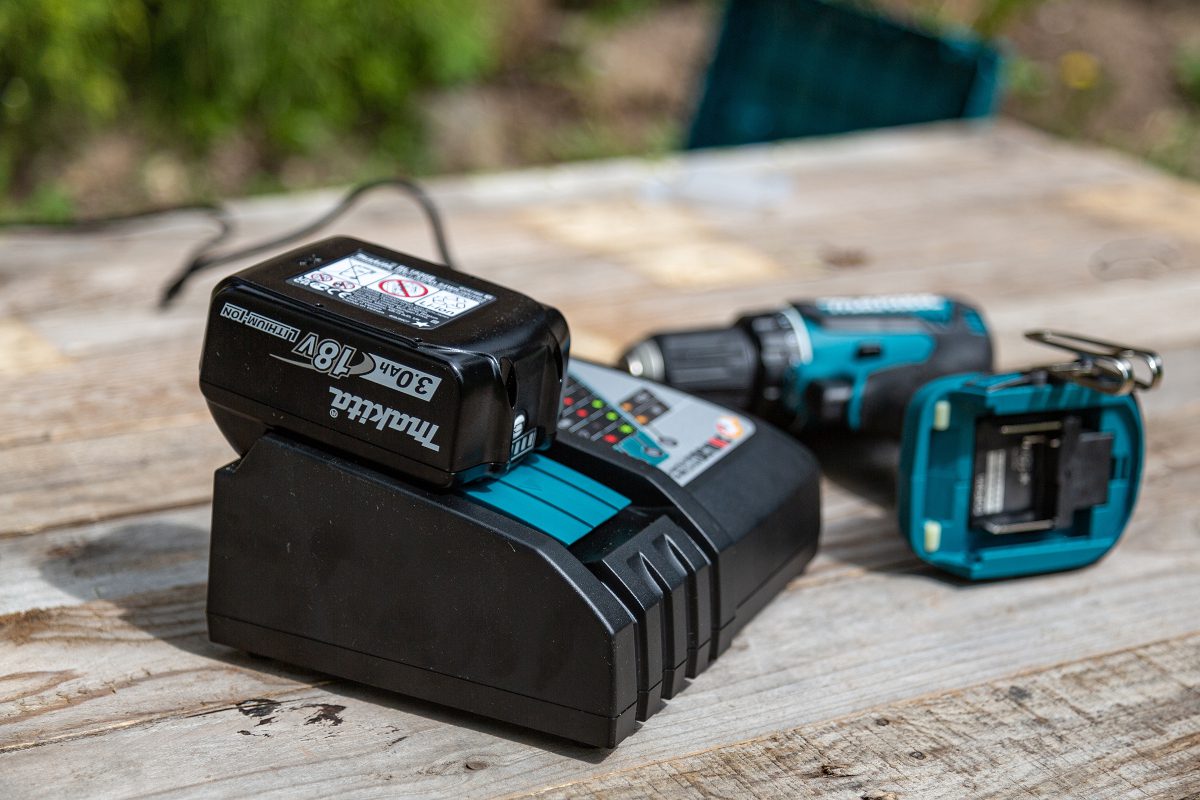
Operating limits apply to tool batteries too
Anyone working on battery systems knows the mechanics: heat speeds up cell degradation, and a degraded cell is more likely to tip into thermal runaway, producing heat faster than it can shed it. What gets less attention is how easily a tool battery ends up outside its limits as many power tool manufacturers give a charging range of around 15 to 30°C. A van parked on an exposed solar farm in July can climb well past that, and the pack charging in the cab is an incident waiting to happen.
Heat is becoming a bigger factor each year and the Met Office says a summer as hot as 2026’s is now about 70 times more likely than it would be in a pre-industrial climate. For crews who spend the season on open sites with little shade, ambient temperature should be included as part of the planning.
Water is another factor that often underappreciated, given renewables work typically takes place in wind and rain, on turbine platforms and at remote field sites, water getting into a damaged casing or a charger is a route to failure. However, it’s also easy to overlook because a pack that got soaked one day can look normal the next.
Engineering habits for portable kit
The engineering sector already understands the bigger picture, so it makes sense to apply that disciplined thinking to the toolbox. A charging environment can be written down as a set of operating parameters covering temperature, direct sun, moisture and ventilation, and the pre-use check works like condition monitoring. If a pack is swollen, discoloured, unusually hot or giving off an odd smell, it comes out of service and gets logged. A technician’s report about a dodgy battery deserves the same response as a fault alarm on an installed system.
Charging needs a few firm rules too, first, packs shouldn’t sit on charge unattended for long periods, and a cab or welfare unit with nobody in it is the wrong place for them. Ventilation does two jobs here as it helps to prevent heat building up during charging, and if a cell fails it lets the gas escape instead of pressurising the space. Charging areas should also get the treatment job sites already give gas bottles and fuel bowsers; ventilated and set apart from nearby infrastructure.
Who sets the conditions
Technicians make most of these decisions, often they do so alone, a long way from a supervisor and that’s why the conditions around them matter so much. Managers decide whether a remote site has a sensible place to charge and whether vans have anywhere cool to keep batteries, but they also determine whether someone who reports a damaged pack is thanked or given the third degree about how it happened. Remote crews need to know that taking a battery out of service won’t leave them without tools for the rest of the shift, so carrying spares is part of the safety plan.
Behaviour matters, but of course physical safeguards matter too. ISO 3941:2026 has added Class L for lithium-ion battery fires because they behave unlike other fires, potentially exceeding 1,000°C, giving off toxic gas and reigniting hours (even days and weeks) later. A well-designed charging unit can contain that but it can’t stop anyone leaving a battery pack to bake in a van.
So, before your next site visit, try a small exercise, write a specification for charging a tool battery on site, the way you would for an installed system, with the temperature range, ventilation, moisture protection, supervision and sign-off all filled in. Any line you’re unsure of is a decision currently being made by whoever happens to be holding the battery.