


Battery dependence could become a sustainability and maintenance liability for large-scale IoT deployment. Ambient energy harvesting may offer an alternative way to power sensors and small connected devices, explain Dr Lethy Krishnan, of the University of St Andrews, and Clara Ko, Head of Technical Sales, Linkam Scientific Instruments
Billions of batteries end up in landfill every year and, while demand for higher capacity, better performing batteries continues to grow for certain applications, notably electric vehicles and mobile tech, their limitations call their widespread use into question. Batteries may not suit every application, especially for small, distributed, long-life devices such as Internet of Things (IoT) sensors. Cutting the battery waste generated through their production and disposal is a significant way to reduce carbon impact and deliver a more sustainable technology footprint. Batteries also degrade, and the operational cost of their replacement or maintenance often exceeds the device cost, particularly at scale.
Different energy conversion mechanisms such as photovoltaic (converting light to electricity), thermo and pyroelectricity (temperature variations to electricity) and piezoelectric (mechanical vibrations and physical motion to electricity) can be used to scavenge these ambient energy sources.
These alternative methods, or ambient energy harvesting techniques, are attracting considerable interest. Energy harvesting or ‘scavenging’ is the process by which useful electricity is generated from the energy sources available in the environment, such as solar, wind and wave power. More recent developments include the potential of capturing small amounts of ambient energy like light, heat, vibration, or radio waves within buildings or homes, and converting that energy into usable electrical power.
Ambient energy harvesting represents a key enabler for the future of scalable, autonomous smart technologies, making the Internet of Things (IoT) – the key technology behind smart buildings, smart cities and Industry 4.0 – battery-independent and self-sustaining, and representing a potentially important source of energy generation to support conventional storage devices.
The Energy Harvesting Research Group at the University of St. Andrews’ School of Physics and Astronomy is investigating the exciting potential of new materials to develop novel ambient energy harvesting materials and devices.
Enabling the adoption of smart technologies
Smart technologies such as the IoT and wearable technology, which are starting to deliver efficiencies in smart homes and cities, and throughout manufacturing and healthcare, are a key way to minimise energy waste. The IoT, however, depends on thousands of small wireless sensors within a smart building, rising to potentially trillions as systems are increasingly adopted. These sensors currently use battery power, which stifles scalability, creates high lifecycle costs in large deployments, requires ongoing maintenance that causes system downtime, and is therefore a barrier to widespread adoption.
Finding an alternative energy source is critical to support the expansion of smart technology, and research into new materials and multi-source energy scavenging technology holds the potential to enhance efficiencies in ambient energy harvesting. New indoor power harvesters that capture the light energy from artificial light sources and the mechanical analogy from human movement and electrical appliances will generate enough energy to power the small sensors in the smart building scenario.
Developing energy harvesters depends on the availability of suitable materials, composition engineering and advanced device architectures.1 Ferroelectric materials are being explored as an exciting future source: they exist in both bulk and thin film forms, and possess permanent and electrically switchable polarisation.2 In thin film form, ferroelectric materials offer significant potential in energy harvesting and storage.
Halide perovskite materials – key to a sustainable future
Oxide perovskite-based ferroelectric materials are widely studied, but have limitations – they are inherently brittle and contain expensive, toxic, and rare materials such as zirconium and Hafnium that require complex processing. Organic ferroelectric materials have also been investigated for their mechanical flexibility, but their application is severely restricted by a low melting point, low spontaneous polarisation and a high coercive field.
Halide perovskites represent the most promising class of materials in emerging ferroelectrics. In addition to their semiconducting properties, halide perovskite materials exist in thin film as well as bulk forms, enabling their integration with IoT and wearable technology, and can be used for light harvesting from the sun and, critically, for light harvesting from the artificial light sources inside buildings.
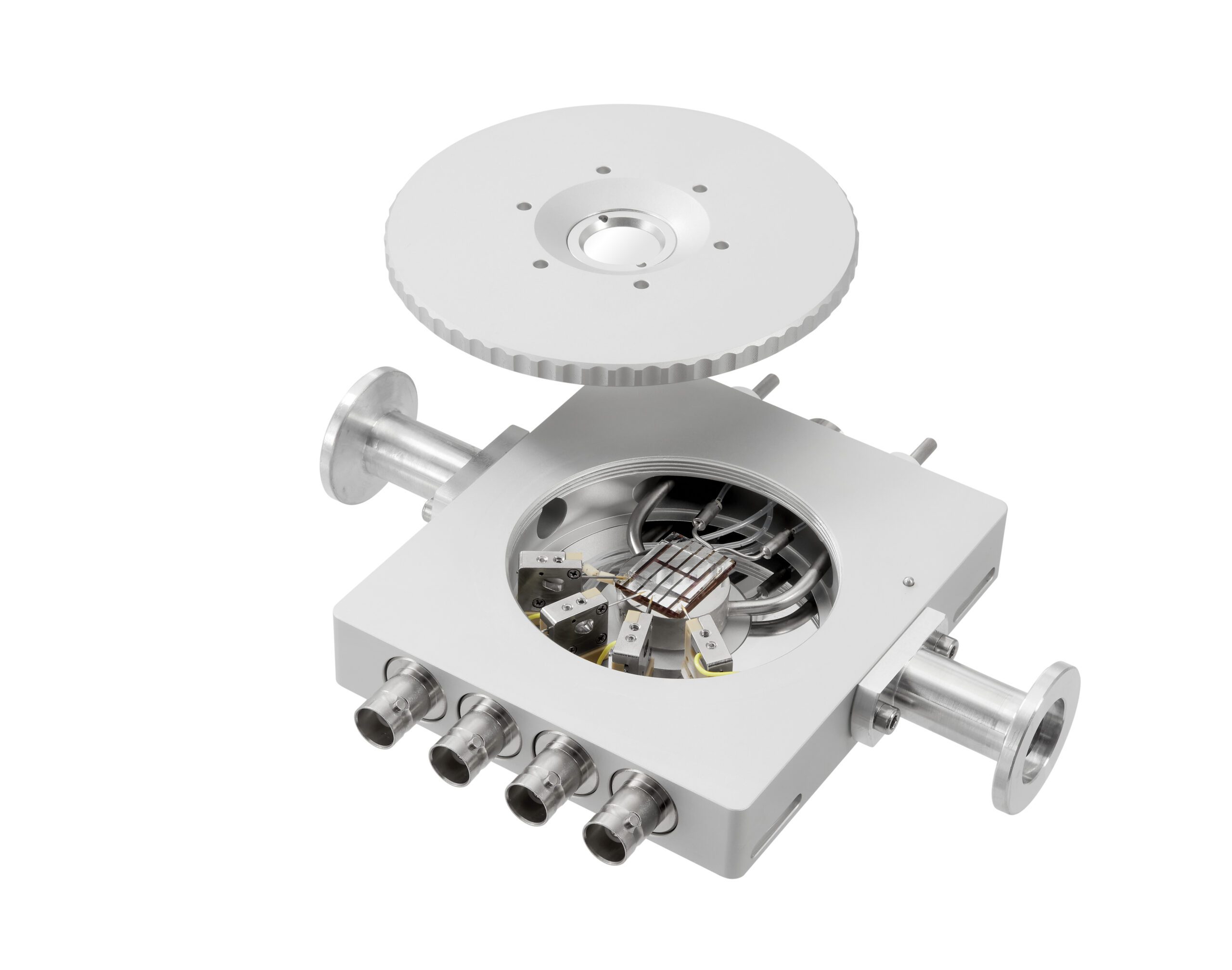
All ferroelectric materials are piezoelectric, and their nature allows them to convert mechanical vibrations and temperature changes into usable electrical energy efficiently. If these ferroelectric materials have semiconducting properties, then they can harvest light to generate electric energy through the photovoltaic effect. Their ferroelectric properties only exist, however, below the Curie temperature, and research into their thermal stability to determine the Curie temperature transition is conducted within a temperature- and environment-controlled stage by measuring a significant change in the materials’ dielectric function. This approach furthered the St. Andrews’ Group’s research in the development of novel ferroelectric thin films based on halide perovskites.
Specialist functionality was also needed to control the environmental properties for research within the stage, including nitrogen, vacuum and humidity, as well as temperature control, as certain halide perovskite piezoelectric materials are susceptible to moisture.
The future is energy scavenging
Perovskite solar cells are primarily suited to green energy harvesting using light from the sun, and this is what is usually studied in photovoltaics. The group at the University of St. Andrews was the first to report on the semiconductive and ferroelectric properties of halide perovskites thin film solar cells that can generate electrical energy through absorbing light and through mechanical sources such as human movement and vibrations.
To bring smart technologies to reality, compact, portable power sources are urgently needed to reduce dependence on batteries. Energy scavenging can power devices for years without needing human intervention, and will be critical for developing smart infrastructure, healthcare sensors, industrial automation, especially in hazardous or inaccessible areas, and self-powered wearable technology.
Notes
[1] V. Pawar, B. Sharma, S. Avasthi, Smart Mater. Sci. Engineer. 2024, 221
[2] R. Muddam, S. Wang, N. Prashanth, M. Raj, Q. Wang, P. Wijesinghe, J. Payne, M. Dyer, C. Bowen, L. Jagadamma, “Self-Poled Halide Perovskite Ruddlesden-Popper Ferroelectric-Photovoltaic Semiconductor Thin Films and Their Energy Harvesting Properties”, Advanced Functional Materials, Volume 35, Issue 34, 22 August 2025. https://doi.org/10.1002/adfm.202425192
About the authors
Dr Lethy Krishnan Jagadamma is a UKRI-Future Leaders Fellow and Reader in Physics at the University of St Andrews, UK, and established the Energy Harvesting Research Group at the university’s School of Physics and Astronomy. During her post-doctoral fellowship at KAUST, Saudi Arabia, she expanded her research expertise to the field of solution-processed thin-film photovoltaics and, in 2015, returned to the UK to join the Organic Semiconductor Centre at St Andrews and continued the research on thin film organic photovoltaics. In 2017, she was awarded Marie-Curie Individual Fellowship to focus her research on the ‘Time-resolved photovoltaic properties of hybrid perovskite semiconductors,’ and in 2020 she was awarded the prestigious UKRI-Future Leaders Fellowship to build her own research team focusing on ambient energy harvesters based on halide perovskite thin films.
Clara Ko joined Linkam Scientific Instruments in 2022 focusing on technical product and business development. Following a BSc in Biology and an MBA in International Management, Clara has since worked for more than 25 years for a variety of multi-national scientific organisations in Asia-Pacific, Europe, and North America.