
For several years, the UK car industry has been claiming that demand is not high enough to meet the government’s targets for sales of “zero emissions vehicles” (ZEVs).
To date, however, the car industry has actually beaten the targets under the government’s “ZEV mandate”.
This pattern of claiming demand is not high enough is being repeated in a regular cycle, following the publication of monthly statistics on new UK car sales by the Society of Motor Manufacturers and Traders (SMMT).
Each month, this messaging is amplified by large sections of the media, which have published dozens of articles stating – incorrectly – that car companies are missing their ZEV targets.
Meanwhile, the car industry is lobbying for an “urgent review” of the targets, on the basis that “natural demand is still well below the level demanded by the [ZEV] mandate”.
UK car market has ‘over-complied’ with its targets
In 2021, the UK’s then Conservative government developed the idea of a “ZEV mandate” as a way to drive sales of electric vehicles (EVs).
The idea, inspired by a similar scheme in California, is to set a rising target for the share of new car and van sales that must be “zero-emissions vehicles” (ZEVs) each year.
For cars, these targets started at 22% of sales 2024, increasing gradually each year to 80% by 2030.
Towards the end of the first year of the scheme, in November 2024, the SMMT warned that the industry was “likely to fall short”, with EVs making up “just…18.7%” of sales. It said:
“The industry looks likely to fall short of the 22% EV market share demanded, potentially creating a £1.8bn bill for compliance.”
(If manufacturers fall short of their target, they can still avoid having to pay a “bill for compliance” by trading “credits” with other firms, or “borrowing” allowances from future years.)
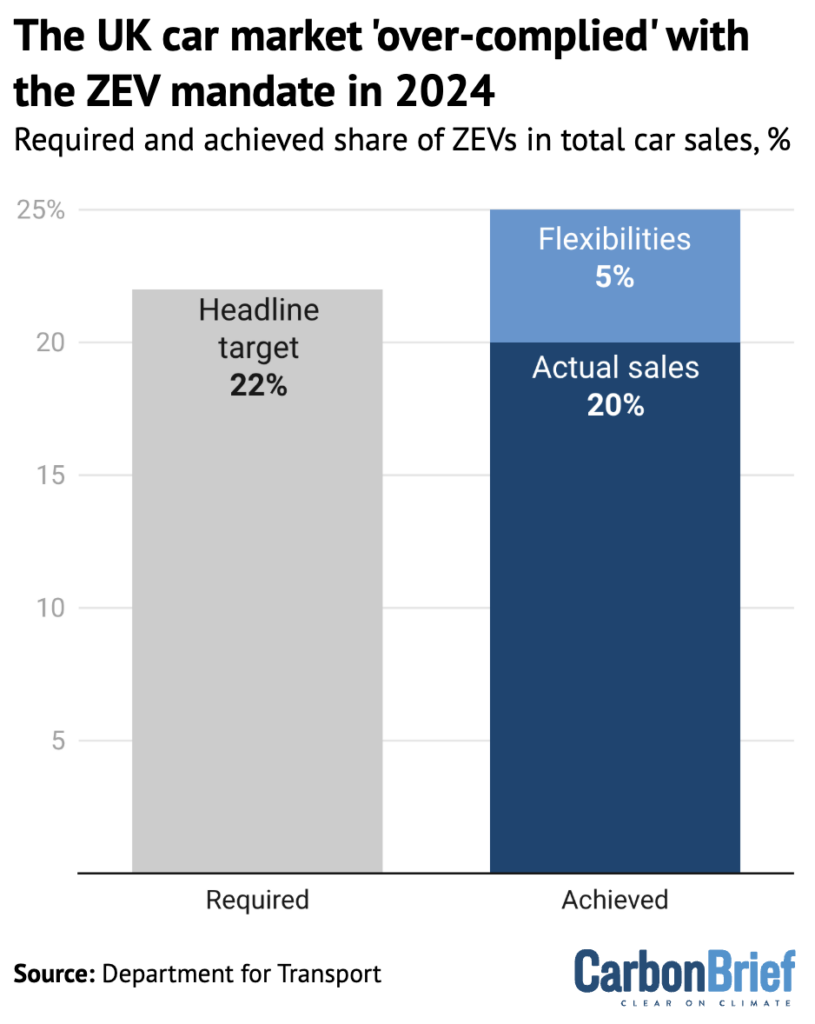
But, contrary to the industry messaging on the headline 22% goal, the car market actually “over-complied” in 2024, according to official figures published in early 2026.
As such, all carmakers in the UK avoided fines for failing to meet their ZEV-mandate targets.
This was despite only 19.8% of new sales being EVs in 2024 – a final tally that was notably more than one percentage point higher than the industry estimate from November of that year.
The industry was able to “over-comply” with the ZEV mandate because the regime has a series of “flexibilities”, which have been created and added to after lobbying by carmakers.
These “flexibilities” allow individual firms to reduce their targets for ZEV sales by selling combustion-engine cars with lower emissions, such as hybrids or plug-in EVs.
When these “flexibilities” are considered, the car market met the equivalent of a 24.5% target, according to the government, with the surplus of 2.5% being “banked” for use in future years. This is shown in the figure below.
In May 2026, the SMMT again told Carbon Brief that EV sales in 2024 had been below the headline target.
When asked by Carbon Brief to confirm that – per the official figures – the UK car market had, nevertheless, “over-complied” with the ZEV mandate in 2024, it did not respond.
Car industry continues to lobby for weaker rules
In a January 2026 release on car sales for the previous year, the SMMT said the “gap between demand [for EVs] and ambition [in the ZEV mandate] is increasing rather than diminishing”.
At the time, Carbon Brief asked the SMMT if it recognised independent estimates from thinktanks and NGOs, showing that – on the contrary – the car industry had also met its ZEV-mandate targets for 2025.
In response, the SMMT sent Carbon Brief a quote from SMMT chief executive Mike Hawes saying that “no one will know” if the industry complied with the 2025 target until official figures come out in 2027.
While this is technically true, the official figures for 2024 showed that the thinktanks and NGOs behind the independent estimates for 2025 had been accurate with their previous forecasts of compliance.
The car industry continues to repeat similar messaging.
The SMMT stated in May 2026 that there is a “persistent gap of around six percentage points against the mandate target” of 33% in 2026 and 38% in 2027. Chief executive Mike Hawes said in the statement that “natural demand is still well below the level demanded by the mandate”.
The gap that the SMMT is referring to is between the headline ZEV targets and the expected level of EV sales, which the body says will reach 27% of all new cars this year and 33% in 2027.
The car industry continues to use these figures to call for a review of the ZEV mandate.
In its latest news release, it says the UK “needs an urgent review” and quotes Hawes saying this should be used to “align policy with market realities”.
These comments are reflected in media coverage, with the Independent, for example, running a misleading headline that says the car market is “still missing government EV targets”. The article adds:
“[T]he industry is still warning that EV demand is not growing quickly enough to meet government targets.”
What neither the SMMT press release nor much of the media coverage mentions is the existing “flexibilities” under the ZEV mandate, which were already expanded last year.
This means the headline 33% goal for 2026 can be met, even if EVs only make up around 25% of sales, according to an estimate of the “real” target published by thinktank New Automotive.
Again, the SMMT expects EVs to make up around 27% of sales this year, which would be comfortably ahead of the “real” target once flexibilities are taken into account.
The government has already pledged to review the ZEV mandate, with the results due to be published in “early 2027”.
In April, car sales platform Autotrader announced that new EVs are now cheaper to buy than petrol cars on average, “for the first time”. EVs were already significantly cheaper to own.



The post Factcheck: What the UK car industry is not saying about EV targets appeared first on Carbon Brief.