

The World Bank has abandoned a target for 45% of the funding it gives developing countries to be “climate finance”, following months of pressure from the Trump administration in the US.
However, a concerted effort by developed- and developing-country shareholders has seen the bank hold onto its “action plan” for tackling climate change.
The multilateral development bank (MDB) – which is headquartered in Washington DC – is the single largest provider of climate finance globally, distributing $39.2bn in 2025 alone, primarily as loans.
Amid widespread aid cuts by developed countries, the World Bank and other MDBs have previously pledged to significantly scale up their climate finance over the next decade.
Despite scrapping its central target, the bank says it will continue to support the demands of its “clients”, many of which have explicitly stated their need for climate-related investment.
Here, Carbon Brief looks at the likely impact of the World Bank’s policy shift and whether it is – as one expert puts it – “mostly a symbolic victory” for the US.
- How does the World Bank support climate action?
- Why has the World Bank abandoned its climate-finance target?
- Why is the World Bank important for international climate finance?
- How will these changes affect global climate action?
How does the World Bank support climate action?
The World Bank is the oldest and largest MDB. It is tasked by its 189 member governments – the bank’s shareholders – with supporting development projects around the world.
The US is the bank’s largest shareholder, followed, in order, by Japan, China, Germany, France and the UK.
Every year, the bank provides billions of dollars – predominantly as loans – to developing countries.
(One part of the World Bank, the International Development Association – IDA – specifically distributes grants to lower-income nations, as well as lower-interest loans.)
Through its financing, the World Bank also has an important role in “mobilising” private investments in developing countries.
In recent years, the bank has increasingly focused on helping developing countries to cut emissions and adapt their economies for climate change.
The World Bank provided $164bn in what it calls financing with climate “co-benefits” between 2020 and 2025.
The largest share of this funding – roughly one-fifth – went to clean energy and electricity access projects. Smaller shares went to areas such as public transport, water supply and sustainable farming.
As the map below shows, the largest recipients of the bank’s climate funds since 2020 have been emerging economies, such as Turkey ($10.3bn), India ($9bn) and Nigeria ($6.3bn).
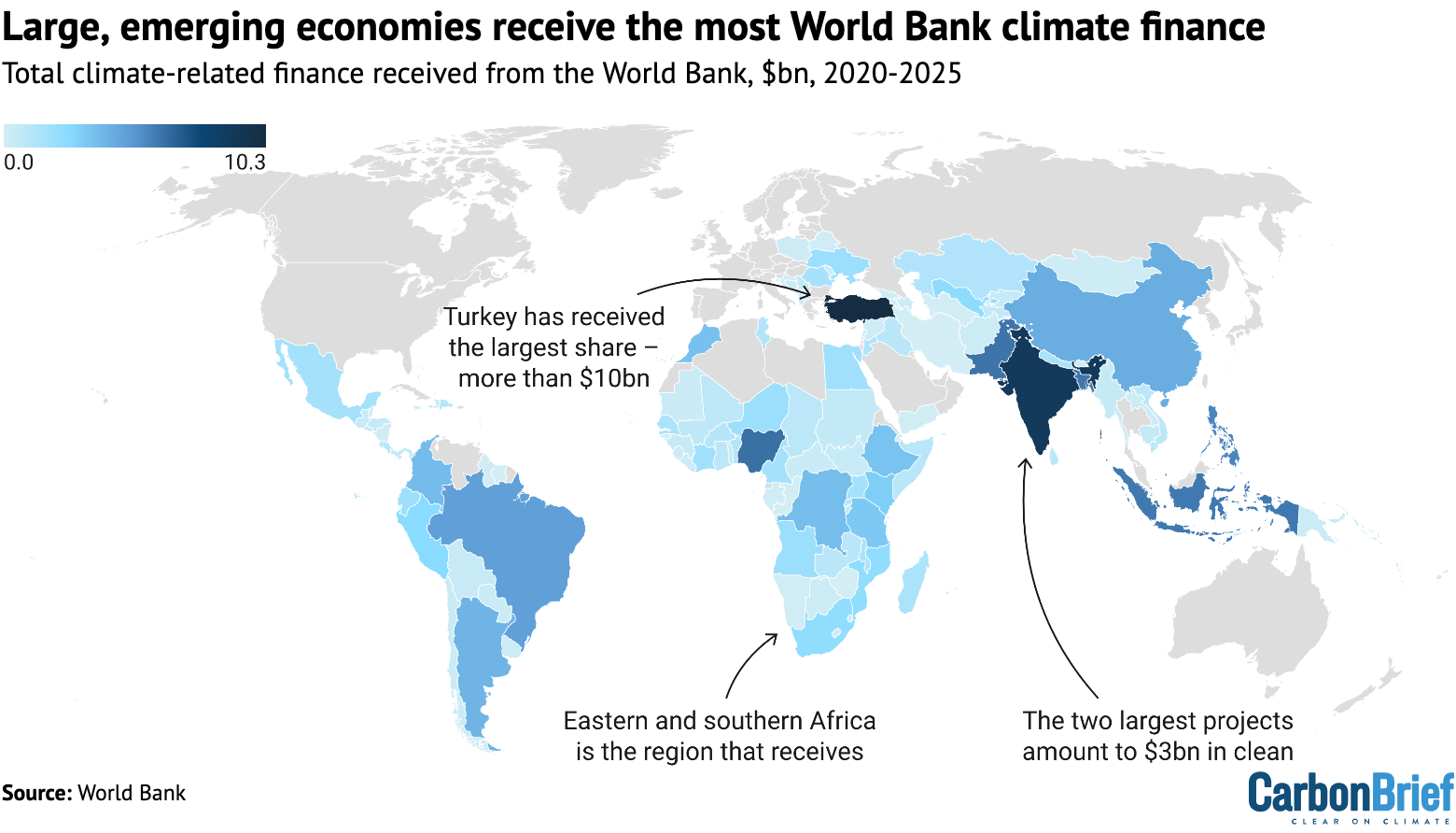
Among the largest World Bank projects in recent years are two extensive programmes in India, totalling nearly $3bn, supporting renewables and green hydrogen.
Others include $1.7bn for a Pakistan hydropower project, $926m for Iraq’s railways and $803m to boost “green development” in Colombia.
Despite the bank’s major role in providing climate finance to developing countries, it has faced heavy scrutiny from climate advocates.
In particular, they have noted the dominance of loans that push developing countries further into debt. The World Bank has also been criticised for a lack of transparency around how it classifies projects as “climate-related”, as well as “over-reporting” of climate finance.
Why has the World Bank abandoned its climate-finance target?
When World Bank president Ajay Banga – nominated by former US president Joe Biden – took over the institution in 2023, there were widespread calls for MDB reform.
Many of the bank’s shareholders wanted to see billions more dollars being channelled to support climate action. Later that year, Banga announced that the bank would ensure that 45% of the bank’s funding was climate finance by 2025.
This replaced an existing target of 35% for climate finance between 2021 and 2025, which had been set out in the bank’s second climate change action plan (CCAP).
The CCAP is intended to “mainstream” climate action in the bank’s work. With it in place, the World Bank’s climate finance more than doubled from $17.2bn in 2020 to $39.2bn in 2025.
As the chart below shows, this meant the World Bank exceeded its 2025 goal, with climate-related projects making up a 48% share of total funding that year.

When Biden was replaced by Donald Trump as president in 2025, the US administration turned against international cooperation, including climate finance.
However, the US did not walk away from the World Bank, where it exerts considerable power as the largest shareholder.
With the CCAP due to expire in July 2026, the US has spent months pressuring the bank and its shareholders to weaken or abandon the plan altogether.
US Treasury secretary Scott Bessent issued a statement during the 2026 World Bank and International Monetary Fund (IMF) spring meetings in April 2026, in which he called for “jettisoning” the 45% climate-finance target. More broadly, he said:
“We welcome the coming expiration of the CCAP and…expect the bank to immediately shift its myopic focus on climate and financing volumes to one that emphasises high-quality, durable projects.”
This vision involves a push for the World Bank to finance more fossil-fuel projects, including drilling for new gas. (The bank has committed since 2019 to stop funding upstream oil and gas projects.)
The decision on whether to continue with the CCAP was negotiated behind closed doors by the board of directors – representing national shareholders. There were reports of “deep divides”.
A joint statement from 19 of the 25 directors last year affirmed the need for both a plan and a target. The US, Russia, Kuwait and Saudi Arabia all declined to sign up, while Japan and India abstained, according to Reuters.
There were reports of European nations championing a climate plan, bolstered by support from the developing countries that would stand to receive climate finance. The US call to drop the 45% target entirely was reportedly backed by Saudi Arabia and Russia.
Ultimately, the day before the CCAP was due to lapse, the World Bank announced what appeared to be a middle ground. It would drop both the 45% target and the 35% goal it had replaced, while also “extend[ing]” the CCAP.
UK development minister Jenny Chapman told a committee hearing in the House of Commons the next day that this marked a “compromise”. She said:
“It wasn’t clear we were going to get a CCAP at all and a bank without an action plan on climate is a problem for us – so that’s a good outcome.”
Supportive shareholders had been pushing for a one-year extension of the plan. While the World Bank did not initially define the length, Chapman confirmed on LinkedIn that the plan had, in fact, been extended “indefinitely”.
The bank said it would also engage an “independent evaluation group” to assess the CCAP, in line with a board request.
Gaia Larsen, director of climate finance at the World Resources Institute (WRI), tells Carbon Brief that this evaluation will likely be “relatively free from political ideology” and could be “focused on how to make the CCAP more effective”.
Why is the World Bank important for international climate finance?
Under the Paris Agreement, developed countries – including major World Bank shareholders in Europe and elsewhere – are obliged to provide climate finance for developing countries.
This includes a target of $300bn a year by 2035, which is expected to largely come from developed countries. One significant way these nations can contribute to this goal is via their support for MDBs, particularly the World Bank.
The World Bank has described itself as “by far the largest provider of climate finance to developing countries”. Each year, it oversees half of all climate finance from MDBs and far more than any single donor country.
Many developed countries have, therefore, enthusiastically backed the World Bank’s climate efforts, as well as a “bigger” role for MDBs in development more broadly. The bank can lend sums that far exceed the amount of new public finance that individual nations are willing to commit.
This is particularly significant, given many of these nations, including the UK, Germany and France, have announced large cuts to their aid budgets in recent years.
Carbon Brief analysis suggests that roughly a fifth of the international climate finance provided and “mobilised” by developed countries in recent years can be attributed to their World Bank contributions, as the chart below shows.
(This only accounts for the World Bank financing that can be linked to developed-country shares in the bank. Developing countries, such as China, also have significant shares, which are not included in the chart below.)

MDBs – including the World Bank – have committed to providing $120bn in climate finance to developing countries by 2030.
This was set to come from greater shareholder contributions, combined with a programme of reforms to free up capital.
If the World Bank continued to provide half of the MDB total, it would need to increase its climate finance by around 50%, from $39.2bn today to $60bn in 2030.
Therefore, experts see a “key” role for the World Bank in achieving not only the $300bn target, but also the more aspirational $1.3n target that countries agreed as part of the “new collective quantified goal” (NCQG) on climate finance at COP29 in 2024. This includes the private capital it could “unlock” through its lending.
Joe Thwaites, international climate finance director at Natural Resources Defense Council (NRDC), tells Carbon Brief that these “NCQG politics” are “quite important”. He says:
“The maths of the $300bn does not work if the MDBs pull back and so I think that’s why you’re seeing developed countries taking a stand.”
How will these changes affect global climate action?
To date, the World Bank has only released minimal details about its new climate plans. As such, experts say the impact on future climate finance remains uncertain.
Jon Sward, environment project manager at the Bretton Woods Project, tells Carbon Brief:
“They have said they are going to retain all the same processes about climate-finance reporting. So, of course, there is a world in which, actually, climate finance continues to increase like it has been.”
Some of the World Bank’s internal organisations will, in fact, keep their climate-finance goals for the time being. For example, the IDA’s largely grant-based funding retains a 45% target for its current round, which will last until 2028 – the year of the next US presidential election.
However, WRI’s Larsen tells Carbon Brief that the changes, from a bank that was previously a “champion for climate action”, remain significant:
“This reality, reinforced by the elimination of the 45% goal, means that it would not be surprising to see a reduction in climate investments.”
In a statement, the World Bank said its “work on climate is and will remain firmly client driven”, noting that it supports nations undertaking their Paris Agreement climate plans.
Therefore, its climate focus may come down to whether there is demand for climate action from “client” countries receiving finance.
At an April event in discussion with the climate sceptic Bjørn Lomborg, Bessent said that global financial institutions should focus on growth, characterising climate action as an “elite belief”.
The implication from the US Treasury secretary was that recipient countries are not interested in climate action. However, as reported by Devex, a group of World Bank shareholders representing nearly 100 developing countries, wrote a letter that appeared to push back against this framing.
This “G11+” group, led by Brazil and China, said the bank “must remain firmly client-driven”, noting that countries are “following nationally determined pathways toward climate action”. NRDC’s Thwaites tells Carbon Brief:
“It’s one thing for the Europeans to talk about climate…This was the client countries [100 developing countries] saying: ‘No, we want this.’”
Recent research by the ODI thinktank found that 79% of developing-country officials polled wanted to see MDB investment in solar projects, 54% wanted hydropower and 47% wanted wind power. Only 13% wanted investment in gas-power plants.
Rishikesh Ram Bhandary, a senior development researcher at Boston University, has stressed the need for an “enhanced CCAP”, which could be supported by the bank’s new independent evaluation. Among other things, he tells Carbon Brief:
“The bank needs to make a more convincing case about how climate change is being integrated into development priorities rather than competing with them.”
Thwaites says he is hopeful that the outcome is “mostly a symbolic victory for the US”.
However, he says major shareholders from Europe and elsewhere should make it clear to the bank that it is not “the only game in town” when it comes to climate finance. He says:
“If [the World Bank] are going to cave into one shareholder, when the vast majority of the other shareholders are supportive of continuing climate action, they can take their money elsewhere.”



The post Q&A: How will the World Bank’s abandoned finance goal affect climate action? appeared first on Carbon Brief.