

China’s provincial-level governments have now all published their 15th five-year plans – economic and social development blueprints for 2026-2030.
These provincial plans reaffirm the overall trajectory of China’s energy transition, but reveal regional differences, based on economic and geographic considerations.
Provincial plans are a critical mechanism for showing how high-level targets from the central government will be translated into action.
For example, binding indicators set at national level include reductions in carbon intensity – carbon dioxide (CO2) emissions per unit of economic output – and the proportion of non-fossil energy in total consumption.
Subsequent targets are then set for each province and tied to the performance evaluations of top local officials, who are ultimately responsible for delivery.
Similarly, provincial plans also build on qualitative policy directives in the national-level plan, such as further developing new-energy vehicles (NEVs) and hydrogen industries.
Specific policies, such as boosting production capacity, appear in several provincial-level plans.
Below, Carbon Brief analyses what the 31 documents say about energy and climate.
What do the provincial plans say about climate goals?
At the broad level, the new provincial plans follow China’s overarching climate goals. All 31 provincial-level jurisdictions in mainland China have pledged to peak carbon emissions before 2030.
Every plan also mentions the core elements of China’s energy transition strategy, including solar, wind, hydrogen, energy storage and upgrading the power grid.
While solar features in every plan, specific interests in the technology vary from province to province.
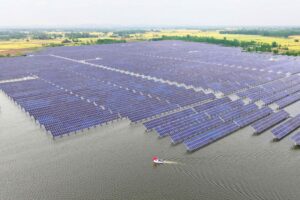
Some set goals to add new solar capacity by 2030. Zhejiang province aims to add 90GW of solar capacity, while Shaanxi plans to “accelerate” construction of wind and solar bases in the north of the province, as well as “solar+” models – such as “forest-solar” and “tea-solar” – in the south. Several plans mention developing offshore solar farms in the next five years.
However, others instead choose to focus on recycling old solar panels or strengthening solar R&D.
The chart below shows the frequency with which key climate and energy terms appeared in the 31 provincial-level five-year plans.
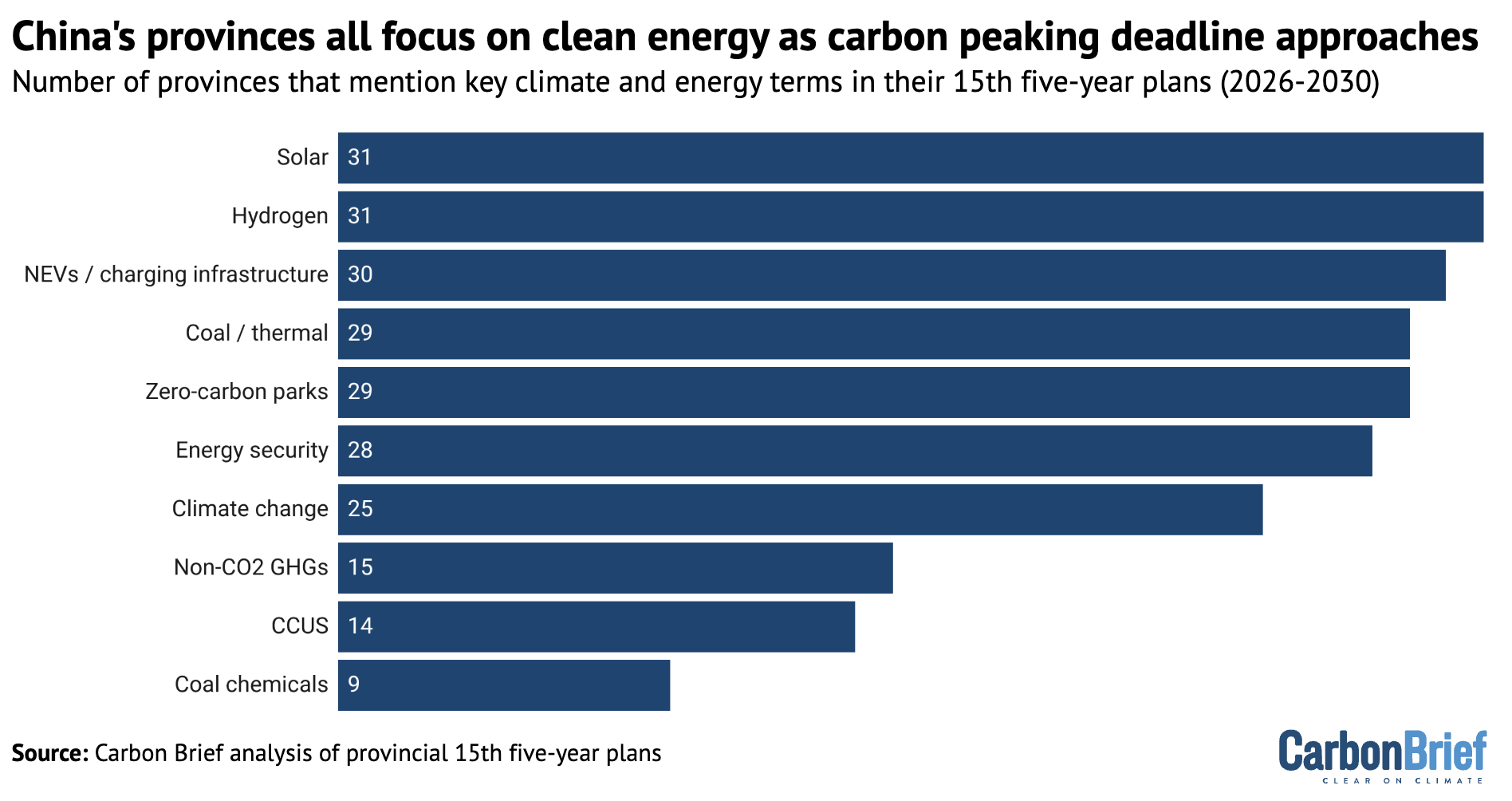
Almost every plan mentions growing consumption and production of NEVs. Growing the NEV industry is seen as an essential step to China becoming “a leading power in automobiles” and “a key strategic move” to address climate change, according to a plan for the sector’s development issued by the State Council in 2020.
Around 15 provinces pledge to promote NEV uptake. Jilin set a target for NEVs comprising more than 50% of new car sales by 2030, although its current rate is already thought to be 47%.
While the central government is issuing directives to limit “overcapacity” in the sector, more than 20 provinces say they will continue developing their NEV industries, with many aiming to generate hundreds of billions – or even trillions – of yuan in value.
Among them are established NEV manufacturing bases such as Shanghai and Chongqing.
Meanwhile, 24 provinces will prioritise developing renewable power “direct connection” models, in which renewable generators supply industrial users via a dedicated line – a system that could boost consumption of clean energy.
Provinces diverge in terms of what other technologies they name and how detailed their plans are.
For example, offshore wind and nuclear are mentioned by 11 and 12 provinces respectively, with both technologies mostly targeted to be built in coastal provinces.
Inland provinces, such as Inner Mongolia, Gansu, Qinghai and Xinjiang, instead focus on developing wind and solar farms across desert regions.
But in general, variation reflects more than just geography or resources endowment, says Anders Hove, a senior research fellow at the Oxford Institute for Energy Studies.
“The differences between provinces reflect primarily differences in economic development capabilities and industrial structure,” he tells Carbon Brief.
Yang Li, deputy executive director at the Beijing-based thinktank Institute for Global Decarbonization Progress (iGDP), echoes this, stating that the variation reflects differences in the resources available to provinces and their own strategic positioning.
Provinces are also increasingly discussing how to manage the decommissioning of solar and windfarms.
Around 19 provinces have set out plans to recycle old clean-energy equipment, a topic that featured in few plans in the previous five-year cycle. While most of the plans that mention the goal only briefly flagged the issue, Inner Mongolia, Jiangsu, Jiangxi and Qinghai have pledged to create dedicated recycling parks or industrial clusters.
How do provinces talk about fossil fuels?
Almost every province has pledged to peak coal and oil consumption, in line with similar language in the national-level plan.
However, 17 local governments also pledge to produce more fossil fuels – trying to peak consumption while also expanding output, opening new reserves or lifting production limits.
Most of these are western and northern regions designated as national energy-supply bases, including Inner Mongolia, Xinjiang, Ningxia, Shaanxi, Gansu, Qinghai, Shanxi, Liaoning, Jilin and Heilongjiang.
Yang tells Carbon Brief this pattern reflects the “two dimensions of China’s [energy] transition”, namely a national-level push for peaking fossil-fuel consumption and a desire for energy security by provinces rich in energy resources.
Provinces that host significant fossil-fuel economies are also the most likely to mention carbon capture and storage, as well as curbs on non-CO2 greenhouse gases.
Carbon capture and efforts to deal with methane, another potent greenhouse gas, appear in 14 plans.
All the provincial plans mention gas. Unlike consumption of coal and oil, which almost every province has pledged to peak, no province has proposed capping gas use.
Several provinces set explicit targets to expand gas production. Sichuan aims for annual gas production of 70bn cubic metres, while Inner Mongolia is targeting 32bn cubic metres by the end of 2030.
Others plan on generally expanding gas extraction, utilisation and infrastructure. Guangdong plans to build several new gas-fired power plants while Henan and Hubei will “accelerate” exploration for and development of oil and gas fields.
Provinces such as Heilongjiang, Sichuan, Chongqing and Tianjin will expand gas storage and pipeline connectivity, framing the fuel as a way to ensure energy security.
Gas occupies a small position in China’s overall energy mix, accounting for 8-9% of primary energy demand and 7% of CO2 emissions. It nevertheless remains a relatively large source of energy for some provinces, such as the industrial hub of Guangdong.
It has often been referred to as a “bridging fuel” that can help countries move away from coal use, with several of China’s policies in the 2010s encouraging coal-to-gas switching. However, in China its growth has slowed in recent years in the face of unreliable supplies and large additions of wind and solar capacity.
Provincial plans to expand gas output, Yang argues, reflect China’s aims to increase overall energy supply under its energy security strategy.
As such, she says, it “should not be viewed as a simple trade-off” between China’s climate and energy security goals. Instead, it is an “inevitable stage” in the country’s “build before breaking” strategy for the energy transition, through which China “maintains a certain level” of fossil-fuel production in the “short- to medium-term” while further developing clean-energy capacity.
What do provinces say about AI and hydrogen?
With the national government preparing to spend trillions of yuan on datacentres for the artificial intelligence (AI) industry in the next five years, provincial officials are also tying AI to their energy systems.
More than 20 aim to use AI to help manage coal mines, power grids, oilfields and forecasting renewables output.
Sichuan, for example, has pledged to apply AI “large language models” across “power grids, power generation, coal and oil and gas”. Shanxi states that it will build a dedicated AI model “for the energy industry”, as well as AI systems for forecasting grid loads and controlling coal mining equipment.
Yang says that “AI+energy” represents a desire by policymakers to use AI to enhance energy governance, but adds that “large-scale commercialisation [of the technology] still has some way to go”.
Hove compares current mentions of using AI in the energy system to similar references in previous plans to concepts such as big data and “Internet Plus”.
Such language, he argues, is “uncontroversial” and its inclusion can be accepted by a wide range of different groups. But he adds that, in his view, AI will not resolve the institutional barriers and market incentives that are currently restricting broader consumption of renewable energy.
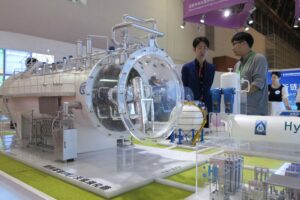
Unlike AI, all provincial plans mention hydrogen, which is named as a “future industry” in the central-level five-year plan.
For example, Hunan calls for promoting hydrogen trucks and rail transport and developing “renewable energy-based” hydrogen production, while Shandong pledges to focus on technological breakthroughs around hydrogen transport and storage, as well as production of green hydrogen.
Similarly, 12 provinces name the other energy-related future industry – nuclear fusion, which remains an experimental technology – as a priority for the next five years. These provinces include Anhui, Guangdong, Hebei, Hubei and Shaanxi.
The post Q&A: What do China’s provincial five-year plans say about climate and energy? appeared first on Carbon Brief.