

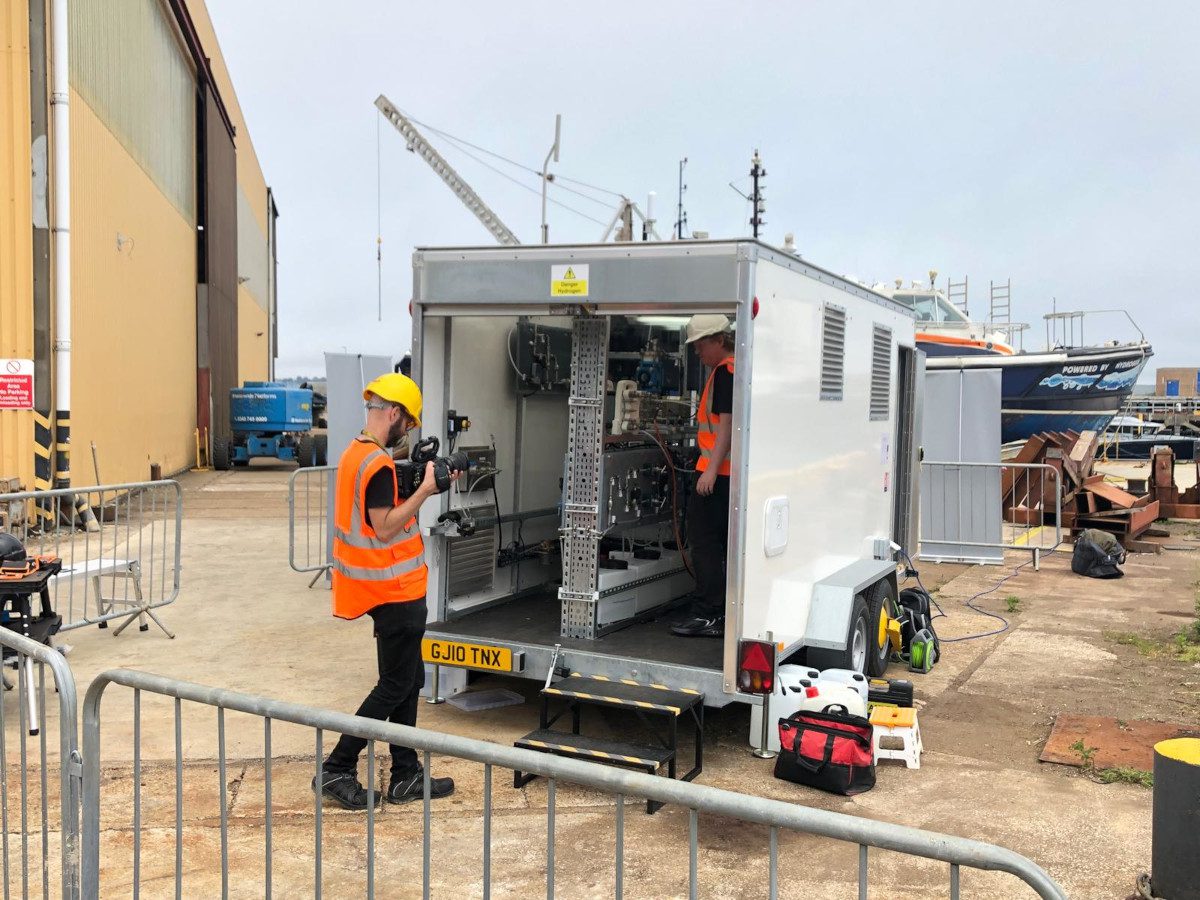
UK green hydrogen firm Latent Drive says it has successfully demonstrated its SeaStack® electrolyser, producing green hydrogen directly from untreated seawater under portside conditions for the first time.
The demonstration took place at Manor Marine’s shipyard based at Portland Harbour, in Dorset, as part of the Hydrogen Innovation Initiative (HII) Demonstration Programme, led by Connected Places Catapult. Installed in a purpose-built trailer system, the SeaStack electrolyser was reported to have produced hydrogen directly from seawater before safely venting it. Latent Drive said it had also achieved a world first in producing hydrogen from wastewaters – successfully processing both sewage treatment works effluent and concentrated brine.
The demo appeared to be a significant development in establishing the direct seawater technology’s readiness, confirming it works as designed in a coastal, real-world environment. As the group explains, the approach appears to solve some of the problems that have been holding electrolyser technology back.
“Unlike conventional electrolysers that require specially purified freshwater before they can operate, SeaStack works directly with wastewater or seawater,” said a press release. “By eliminating the dependency on scarce freshwater supplies, the technology reduces the cost of green hydrogen, while also being uniquely suited for offshore and coastal deployments. Extending this to a range of wastewaters also opens up new markets for SeaStack in water treatment, bio-remediation and industrial locations.”
On-the-day demos showed how SeaStack’s hybrid bipolar plates avoid the formation of corrosive chlorine compounds; a problem that has traditionally plagued other attempts at seawater electrolysis. Proprietary electrodes, known as Catrodes®, use commercial stainless steel treated by Latent Drive’s patented electro-chemical synthesis process, which the group said dispenses with the need for rare metals, lowering the cost of electrolyser production.
Joseph Ely, technical director at Latent Drive, said: “We came to Portland to prove SeaStack works in the real world, and it did. That’s green hydrogen produced portside from seawater, wastewater and brine – on schedule and within our development trajectory.
“The green hydrogen market is projected to be worth over $640 billion by 2030. SeaStack is designed to address the barriers that have so far held the market back and our successful demonstration, supported and funded by the Hydrogen Innovation Initiative, shows it is primed to do exactly that.”
Latent Drive said the HII demonstration advances SeaStack to Technology Readiness Level 5 (TRL5), and “further trials later this year will show the full production-to-use hydrogen pathway in a live maritime environment”.
The next major milestone on the horizon is the successful completion of the HydroPort project, supported by Innovate UK and scheduled for September 2026, which aims to demonstrate green hydrogen from SeaStack being used to fuel a working vessel operating within Portland Harbour.
“Together, these demonstrations constitute the key steps on Latent Drive’s scaling strategy, from kilowatt-scale to full deployment of 500kW assets by 2027 and gigawatt scale by 2030.”
For more information on Latent Drive and its technologies, visit latentdrive.co.uk