
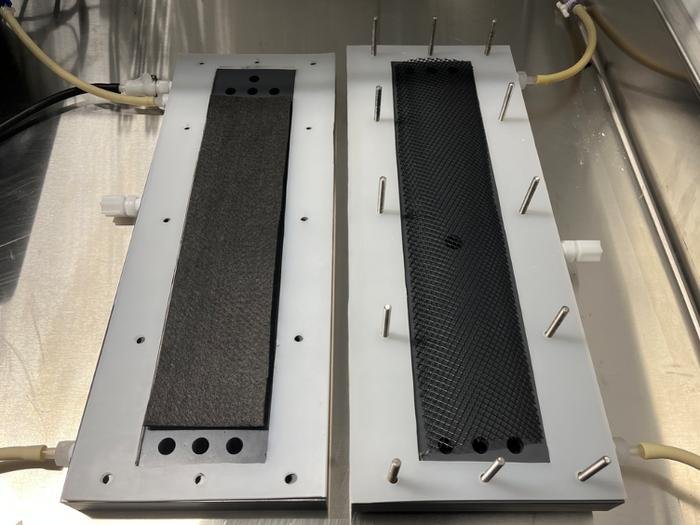
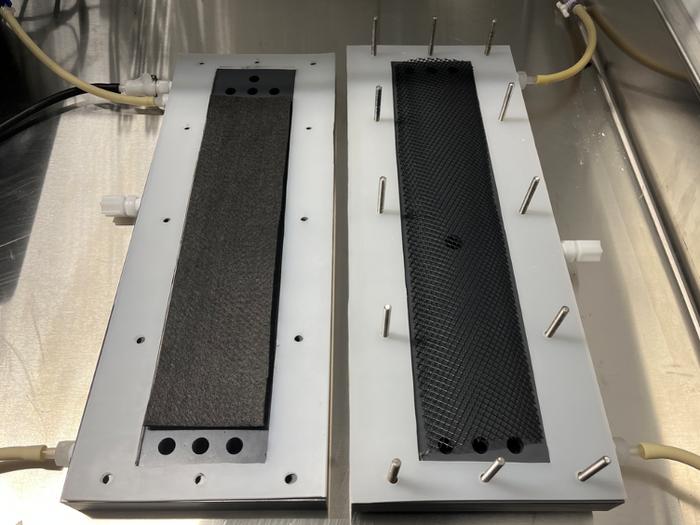
US researchers have developed a microbial electrosynthesis reactor system that converts carbon dioxide and renewable electricity into methane, while demonstrating that the technology can be scaled up roughly tenfold without losing efficiency — a step that could help move the long-studied approach beyond laboratory-scale systems.
The work addresses one of the central challenges associated with renewable energy: long-duration energy storage.
“Traditionally, large-scale, long-term storage means pumping water uphill and letting it flow back down through turbines,” said Bruce Logan, director of Penn State’s Institute of Energy and the Environment and corresponding author on the study. “If you’re talking seasonal storage, you really need to put that energy into a chemical form.”
The system uses electricity from renewable sources such as solar and wind to split water and generate hydrogen. Methanogenic microorganisms then consume the hydrogen and combine it with carbon dioxide to produce methane — the primary component of natural gas.
“The big picture is that we can use low-cost renewable electricity to make methane that can go into existing storage and pipeline systems,” said Logan, Evan Pugh University Professor and Kappe Professor of Environmental Engineering in Penn State’s Department of Civil and Environmental Engineering.
Researchers said microbial electrosynthesis has historically struggled with low efficiencies and difficulties scaling up beyond small experimental devices. The new study focused on overcoming those barriers through reactor design.
The team developed an enlarged “zero-gap” reactor configuration in which electrodes are separated only by a membrane, reducing internal electrical resistance and improving energy transfer efficiency.
According to the researchers, the redesigned system increased electrode area by approximately tenfold while extending the flow path to nearly one foot. Despite the larger dimensions, the reactor maintained stable performance.
“Even though we made the system much bigger, the internal resistance didn’t get worse,” Logan said. “That’s because we were able to use the hydrogen coming off the electrodes much more efficiently.”
The reactor also uses multiple flow ports to improve the distribution of gases and liquids throughout the system, helping maintain consistent operating conditions.
In laboratory tests conducted at 30°C, the system produced up to 6.9 litres of methane per litre of reactor volume per day. Researchers reported coulombic efficiencies above 95%, meaning most of the electrical energy supplied to the reactor was converted into methane rather than unwanted byproducts.
Energy efficiency reached approximately 45% to 47%, which the researchers said places the system among the best-performing microbial electrosynthesis technologies reported under standard conditions.
“We’re taking electricity and turning it into methane at an efficiency on the order of 45% to 47%,” Logan said. “Starting from carbon dioxide and electrons and upgrading that into methane — that’s pretty good.”
The study also sheds light on the mechanism driving methane production in the reactor.
Rather than relying on microorganisms to directly extract electrons from electrodes — a comparatively slow process — the system first generates hydrogen through water splitting. Methanogens then rapidly consume the hydrogen to produce methane.
“We split water to make hydrogen, and the methanogens are right there to use it immediately,” Logan said. “You can think of it as a water electrolyzer, which uses electricity to split water into hydrogen and oxygen, combined with a biological system.”
Researchers said the hydrogen-mediated approach enables higher current densities and faster methane production than earlier microbial electrosynthesis methods.
The findings suggest the technology could eventually be integrated with renewable energy facilities to provide long-duration energy storage using existing gas infrastructure.
“I see methane generation plants built next to solar or wind farms,” Logan said. “Instead of putting electricity onto the grid, you use it on site to produce methane and inject that into gas lines.”
The researchers noted that commercial viability will depend heavily on access to low-cost renewable electricity, continued improvements in reactor materials and careful control of methane leakage, which could undermine climate benefits if emissions escape into the atmosphere.
Even so, the work points toward a possible pathway for recycling carbon dioxide into a storable and transportable fuel using renewable energy.
“We don’t need to dig methane out of the ground,” Logan said. “We can use carbon dioxide we’re already producing and turn it into something useful.”
The study was published in the journal Water Research.