
Recovering energy from water infrastructure using pumps operated in reverse is hardly a new idea. But as Easy Hydro tells Envirotec, improved equipment selection and control could make the technology economically viable at sites where conventional hydropower has struggled to justify its cost.
Water utilities routinely dissipate energy that could otherwise be recovered. Wherever water flows from a higher to a lower pressure, whether through a pressure-reducing valve, a treatment works or a transmission pipeline, there may be an opportunity to generate electricity.
One approach involves operating a conventional centrifugal pump in reverse, allowing flowing water to drive its impeller and turn an electrical generator. Known as a pump-as-turbine (PAT), the arrangement offers a potentially inexpensive alternative to purpose-designed hydropower equipment.
The principle has been understood for decades, but its application has produced mixed results. “Whilst there were some successes, there were also many tales of disappointment with poor efficiencies, and therefore returns were not as good as expected,” says Mike Pedley, commercial director of Easy Hydro, speaking of the technology’s earlier history. His own Dublin-based firm believes a more systematic approach to matching equipment with site conditions can address these shortcomings.
The company emerged in 2020 from research at Trinity College Dublin, where work beginning around 2012 investigated how to optimise pumps operating as turbines.
Easy Hydro combines this research with information obtained through collaboration with selected pump manufacturers, examining the performance of pumps, generators and control systems in energy-recovery applications.
The objective is to select equipment that operates efficiently under the particular pressure and flow conditions encountered at each site.
The economics of energy recovery
A purpose-designed turbine will generally achieve higher efficiency than a PAT, but the difference in capital cost can be substantial.
This is particularly important in retrofit applications, where much of the existing pipework and civil infrastructure can be reused. The turbine, generator and controls may therefore account for a significant proportion of the investment.
Easy Hydro argues that a carefully selected PAT can deliver a better financial return than a more efficient, bespoke turbine, provided the performance penalty is sufficiently small.
“Whilst a PAT will almost never match the efficiency of a made-to-measure turbine, it is usually much, much cheaper and often available off-the-shelf or on relatively short lead times,” says Pedley.
The company says most of its installations involve sites with more than 10m of available head (the pressure or elevation difference available for energy recovery) and flows exceeding 10 litres per second.
Neither figure represents an absolute threshold. Lower-head applications are possible, although they typically require larger flows and different pump geometries. At the opposite extreme, very high heads or flows may favour purpose-designed turbines.
Flow variability is another consideration. PATs generally have a narrower optimum efficiency range than bespoke turbines, making them particularly suitable for predictable operating conditions.
Where flows fluctuate substantially, two PATs operating in combination may provide a more economical solution than a single purpose-built turbine.
“Once again it comes down to understanding the parameters of each site,” says Pedley.
Performance in practice
Two installations in Spain illustrate the scale of energy recovery possible in water utility infrastructure.
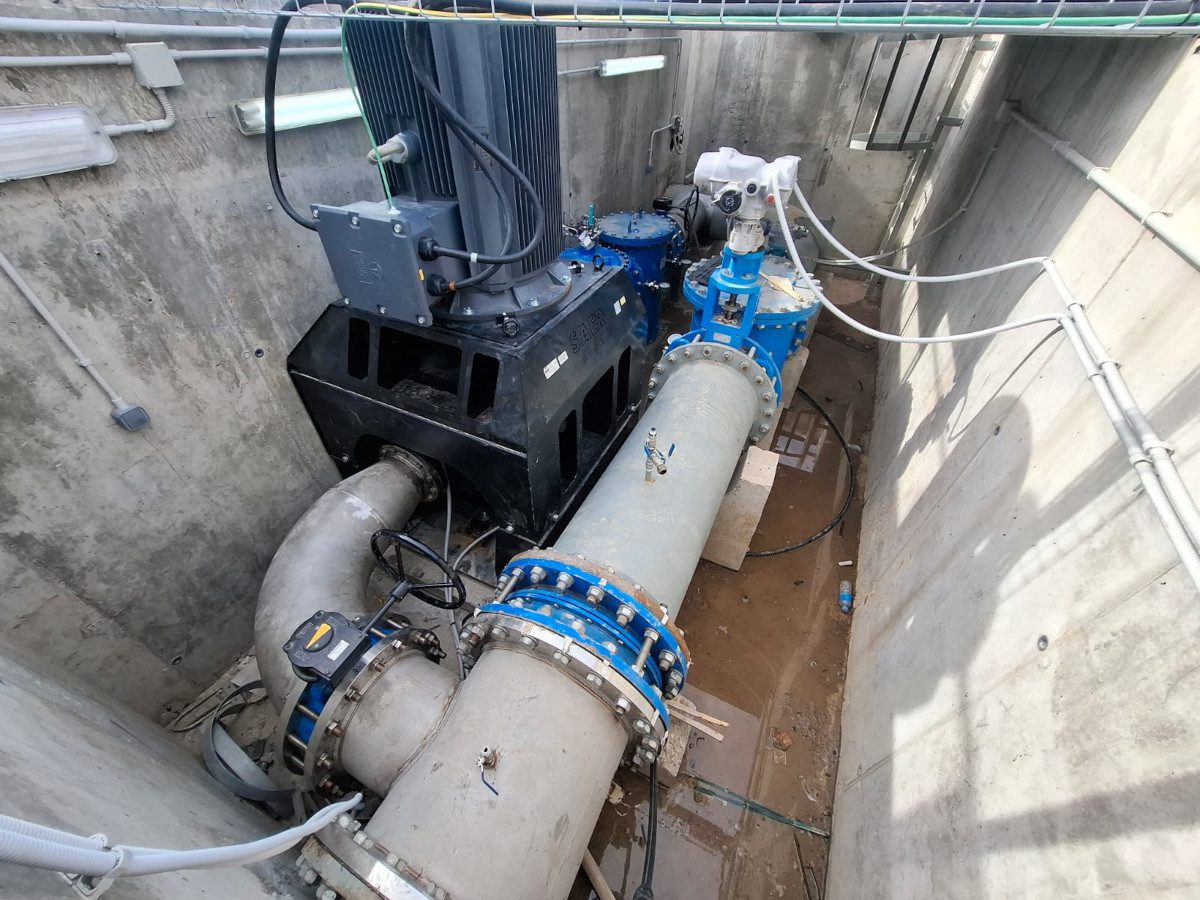
At the inlet to a water treatment works, raw water previously passed through a pressure-reducing valve. Easy Hydro installed a PAT in a bypass arrangement, working within limited available space.
The installation operates with approximately 70m of head and a flow of 330 litres per second, providing a maximum design output of around 180kW.
Easy Hydro reports annual electricity generation of approximately 1,200MWh.
A second Spanish installation recovers energy from treated-water transmission infrastructure, where incoming pressure was not required for onward distribution.
Operating with 65m of head and a flow of 175 litres per second, the system has a maximum design output of approximately 78kW and reportedly generates around 620MWh annually.
These figures, supplied by Easy Hydro rather than independently verified, provide useful indications of the output achievable where substantial pressure and relatively consistent flows are available.
The annual generation figures also reflect site-specific operating conditions and should not be interpreted as typical yields for installations of comparable capacity.
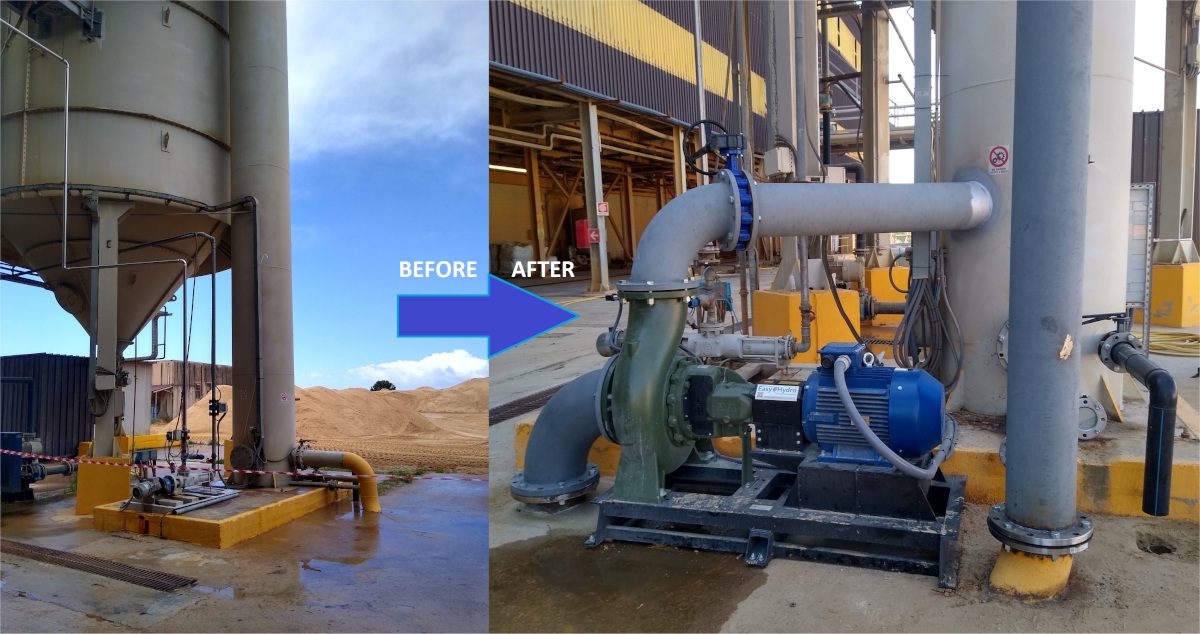
A smaller industrial application in Italy demonstrates a different opportunity.
At a mineral-processing facility, wastewater is treated in a large clarifier before flowing into a storage reservoir and being recirculated through the process.
A PAT installed at the clarifier outfall exploits approximately 10m of head and flows of up to 190 litres per second, giving a maximum design output of around 11kW.
The installation allows the operator to recover some of the energy associated with an existing water-management process without changing its underlying purpose.
Payback and practical limitations
The economics depend heavily on installation requirements.
Retrofit projects may involve modifications to pipework, electrical connections, control systems and existing pressure-management arrangements. These costs can vary considerably between sites.
Easy Hydro generally concentrates on designing and supplying the electromechanical equipment, with water utilities often using their established capital delivery contractors for installation.
The company says many customers seek, and achieve, payback periods well below five years, although it has not provided independently verified project costs or financial savings for the examples described.
Some of its fastest paybacks have reportedly occurred in industrial cooling systems, where energy recovery has been accompanied by improvements to the wider cooling process.
For water utilities, generation must also remain compatible with their primary operational obligations. Maintaining adequate downstream pressure, accommodating variations in demand and ensuring reliable water supply take precedence over electricity production.
Consequently, an attractive theoretical energy resource does not necessarily translate into an economically viable installation.
Untapped UK potential
Although Easy Hydro has operational installations in Ireland, Spain, Italy, France and Norway, its presence in the UK water sector remains limited.
The company has undertaken feasibility studies and outline designs for a small number of UK utilities, but these have not progressed to operational installations. Wider adoption may still be hampered by disappointing experiences with earlier installations. “Some companies still carry the scars from failed or poor returns on PATs installed during that time,” says Pedley.
Easy Hydro points to a project in Norway where it replaced an older, inefficient PAT at a water utility. The company was also able to reprogramme and reuse some of the existing control equipment, reducing replacement costs.
Similar opportunities may exist within UK water networks, particularly where ageing equipment could be upgraded without extensive changes to the surrounding infrastructure.
The wider potential extends beyond drinking-water distribution to treatment works and industrial water systems wherever usable pressure or elevation differences are present.
PAT technology is unlikely to displace purpose-designed turbines in applications where their higher efficiency justifies the additional cost. Its attraction lies instead in making smaller or previously uneconomic energy-recovery projects worth reconsidering.
For operators seeking to reduce electricity purchases and improve the efficiency of existing assets, the question is increasingly whether pressure currently being dissipated could instead be put to productive use.