

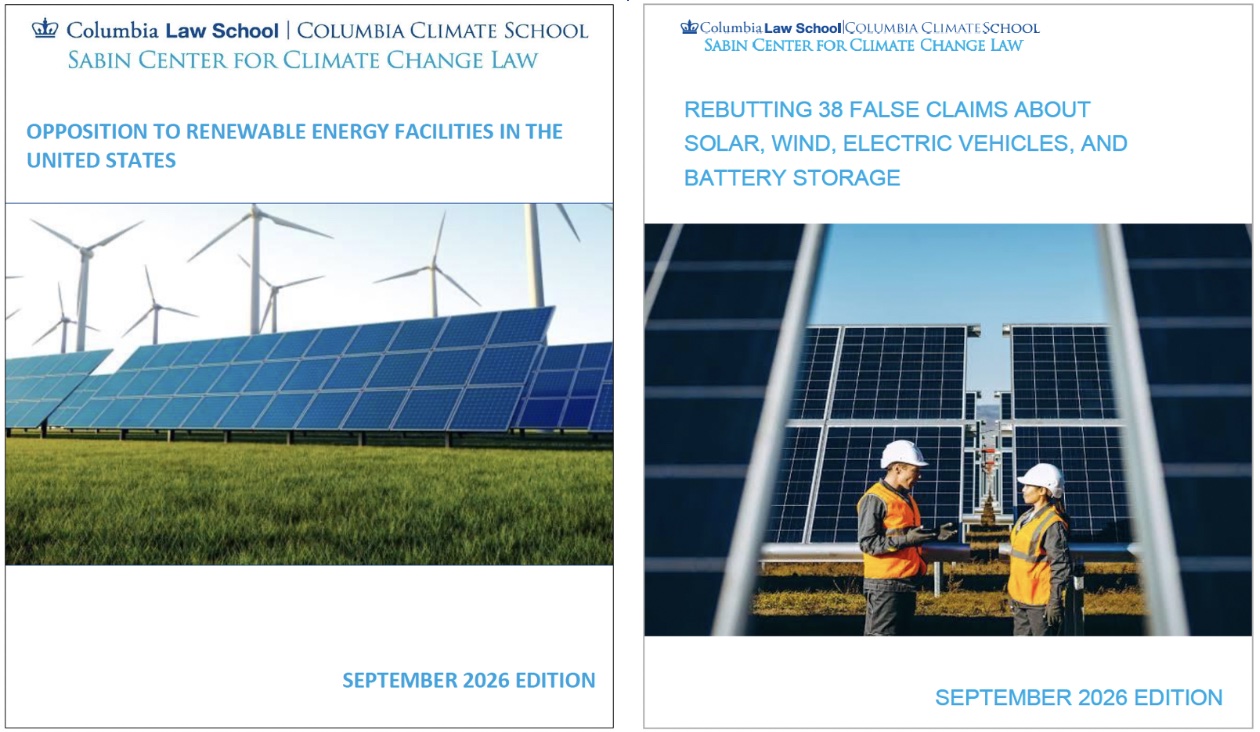
Two major new reports, published today by the Sabin Center’s Renewable Energy Legal Defense Initiative (RELDI), highlight key challenges facing renewable energy development in the United States. The 6th edition of Opposition to Renewable Energy Facilities in the United States identifies nearly 900 state laws and local ordinances that restrict the siting of renewable energy facilities, and over 550 individual renewable energy projects that have faced significant local opposition, often culminating in the filing of lawsuits or other actions to block their development. These problems are widespread: our analysis reveals that there is not a single state in the U.S. where renewable energy development has not been impacted by state or local restrictions or opposition. This opposition frequently stems from, and/or is heightened by, mis- and dis-information about renewable energy development which is often spread by the fossil fuel industry and its supporters. In Rebutting 38 False Claims About Solar, Wind, Electric Vehicles, and Battery Storage, the Sabin Center examines common misconceptions about renewable energy development and explains why they are unfounded.
Tracking Local Opposition to Renewable Energy Development
The Sabin Center has been tracking local opposition to renewable energy development for several years. Our first comprehensive report on the topic was published in 2021 and we’ve since updated it annually. With each update, the picture has become more troubling. The newly published sixth edition continues this trend, demonstrating that state and local restrictions on the siting of renewable energy projects, and instances of organized opposition to such projects, are even more widespread and damaging than our previous work suggested.
By the end of 2025, at least 888 state laws and local ordinances restricting the siting of renewable energy projects had been adopted across 48 states. This number is significantly higher than that reported in the 5th edition of the report (published in 2025). This is due partly to new restrictions being adopted in 2025, but also partly to improvements in our data collection processes, which enabled us to identify additional restrictions from earlier years.
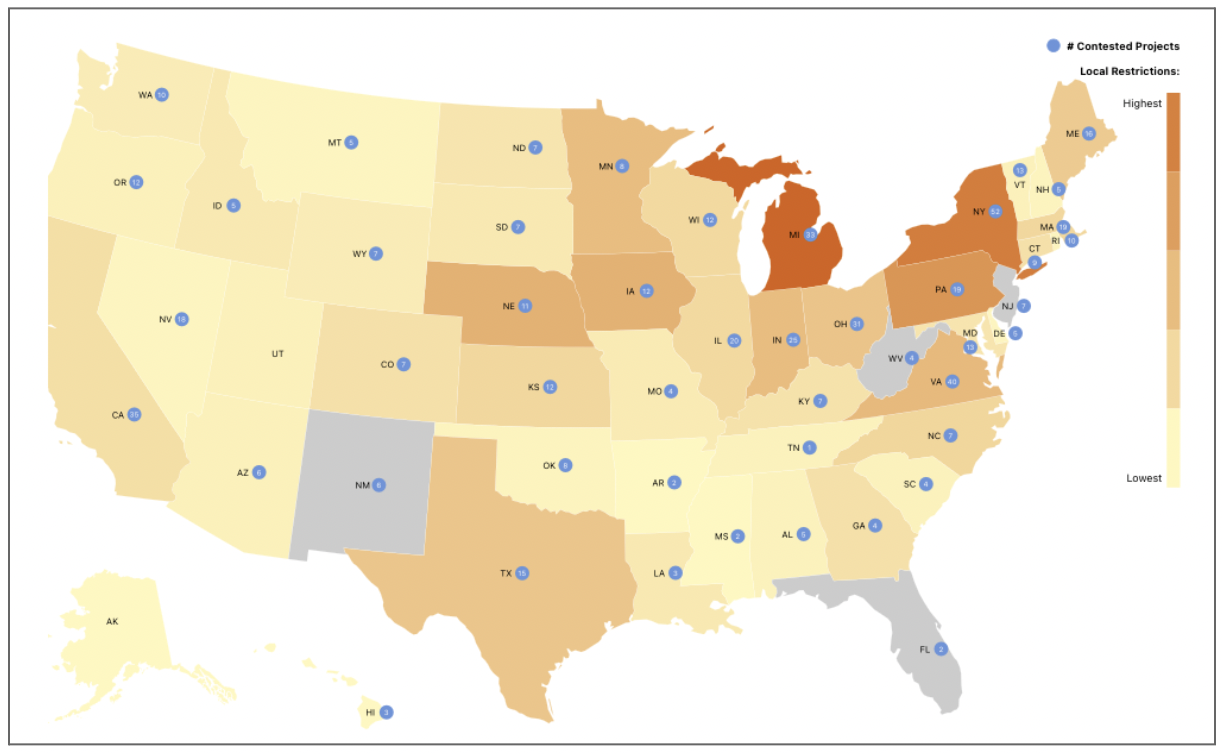
Most of the restrictions we identified – 865 of the 888 total – were adopted at the local level. At the state level, we identified 23 state-level restrictions adopted in 19 states. At least 3 new state restrictions were adopted in 2025 alone:
(1) The Arkansas state legislature enacted the Wind Energy Development Act of 2025, establishing restrictive setback requirements for wind energy facilities;
(2) In Louisiana, House Bill 459 of 2025 was passed, requiring solar energy facilities to comply with onerous setback requirements and strict noise limits; and
(3) The Renewable Energy Certainty Act of 2025 was enacted in Maryland, imposing an acreage cap for solar energy development on certain farmland classified as “priority preservation areas.”
Wind was the technology most commonly targeted in state and local restrictions. At least 416 (out of the 888 total) were directed solely at restricting wind energy development, 294 specifically targeted solar energy projects, and 123 covered both technologies.
We also identified 567 renewable energy projects across 48 states that have faced significant local opposition. These included 217 projects with a wind component, 322 with a solar component, 41 with a battery storage component, and 17 with a transmission component. Notably, approximately 40 percent of these projects have been cancelled, though this may not be solely due to local opposition.
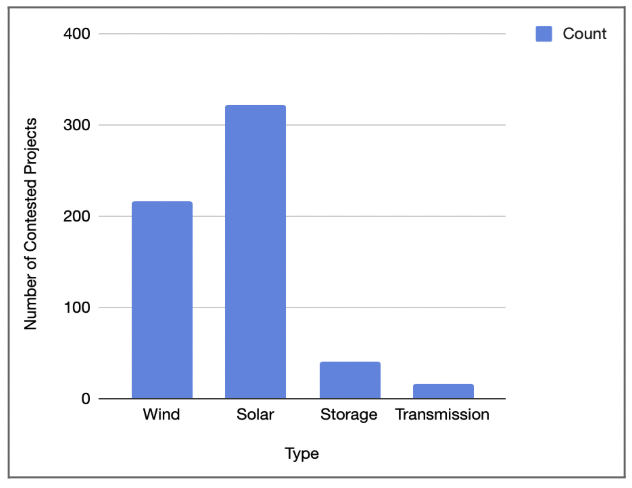
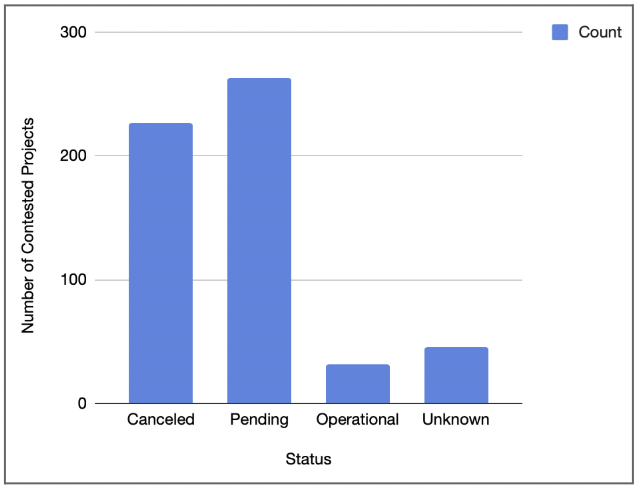
Contested Projects by Type Current Status of Contested Projects
Despite these challenges, there are some reasons for optimism. As explained in the report, there are signs that the rate of adoption of new restrictions may be slowing, especially in states, like Michigan, which have recently enacted legislation to streamline the siting of renewable energy projects. Similar legislation is being considered in several other states and, if enacted, could help to smooth the path for renewable energy development.
Combatting Mis- and Dis-information About Renewable Energy Development
Recognizing that local opposition to renewable energy projects is often driven by mis- and dis-information, in 2024, the Sabin Center published a report rebutting 33 common false claims about wind, solar, and electric vehicles. The new report published today updates and expands that report. In the new version, we address 5 new false claims – relating to the national security risks of offshore wind development, the affordability of electric vehicles, and the impacts of battery storage projects – that have become increasingly common in recent years. The new edition also references newly published studies and other research that further support the rebuttals of the 33 false claims in the original report.
Our goal is not to establish that renewable energy deployment has no adverse impacts or that all arguments made against it are baseless. On the contrary, we recognize that development will have benefits, drawbacks, and tradeoffs. The goal of our new report is to ensure that discussions on these issues are based on the most accurate and up-to-date information and combat the mis- and dis-information that is so prevalent in the renewable energy space and has such a big impact on whether and how projects move forward.
About RELDI
These two new reports were prepared as part of the work of the Sabin Center’s Renewable Energy Legal Defense Initiative (RELDI). RELDI conducts independent research on issues related to the siting of renewable energy infrastructure and facilitates pro bono legal representation to community groups and local residents who support renewable energy projects in their communities that are facing opposition.