
Welcome to Carbon Brief’s DeBriefed.
An essential guide to the week’s key developments relating to climate change.
This week
‘Leeway’ for fossil fuels
METHANE EXEMPTION: The European Commission is considering making changes to its flagship methane emissions regulation to give fossil-fuel companies “leeway to avoid penalties…in what would be a major win for the oil and gas sector”, reported Politico. According to new draft government guidelines seen by the outlet, “national authorities would be able to grant exemptions to companies on energy security grounds”. A separate Politico story said the move comes after the Trump administration “has intensified pressure on the regulation”.
GAS EXPANSION: The Guardian reported that the Norwegian government has been “heavily criticised for approving plans to reopen three North Sea gasfields nearly three decades after they were closed”, with the justification of helping to “fill the gap in energy supplies created by the Middle East war”. Oslo has also given its approval for oil and gas companies to explore 70 new locations in the North Sea, Barents Sea and Norwegian Sea, the newspaper added.
RENEWABLES INVESTMENT: The Financial Times reported that investors are “piling into clean-power funds at the fastest pace in five years as the Iran war accelerates a global push for energy security and alternatives to oil and gas, boosting a slew of stocks linked to the transition away from fossil fuels”. It added that more than £3bn has been invested in global funds linked to renewable energy in April, bringing their total net asset value up to $43bn.
Around the world
- SHIPPING TALKS: Nations are “back on track” to adopt a framework for curbing global shipping emissions, following the latest International Maritime Organization’s meeting in London, according to a Carbon Brief Q&A.
- SUPER El NIÑO: Global sea temperatures were the second highest on record for the month of April, “stoking concerns among scientists that an El Niño warming cycle is brewing that would intensify extreme weather”, reported the Financial Times.
- ROUND-THE-CLOCK: An International Renewable Energy Agency (IRENA) report found that “solar and wind power paired with battery storage systems are already delivering reliable, round-the-clock electricity at a lower cost than fossil fuel-dominated energy systems in a growing number of regions”, said BusinessGreen.
- KENYA FLOODS: At least 18 people have died in floods and landslides driven by heavy rain in Kenya, reported Al Jazeera.
0.15C
The average amount by which trees lower summer temperatures in cities globally, according to research in Nature Communications.
Latest climate research
- Airborne microplastics and nanoplastics have the potential to contribute to warming by absorbing sunlight | Nature Climate Change
- A mega tsunami in Alaska in 2025 was “preconditioned by glacial retreat caused by climate change” | Science
- “Net-zero global power systems meeting universal electricity needs for decent living standards are technically feasible” | Nature Energy
(For more, see Carbon Brief’s in-depth daily summaries of the top climate news stories on Tuesday, Wednesday, Thursday and Friday.)
Captured
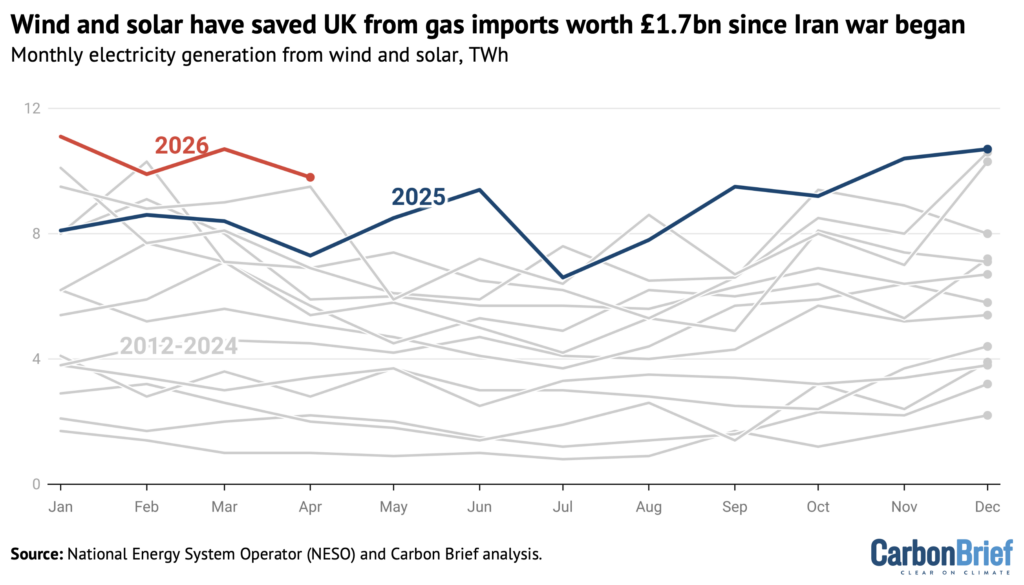
The UK has avoided the need for gas imports worth £1.7bn since the start of the Iran war, as a result of record electricity generation from wind and solar, according to Carbon Brief analysis. The chart above shows that wind and solar have generated a record 21 terawatt hours (TWh) on the island of Great Britain since the end of February 2026, when the US and Israel first attacked Iran. The record wind and solar output avoided the need to import 41TWh of gas – roughly 34 tankers of liquified natural gas (LNG). Importing those 34 tankers of LNG would have cost around £1.7bn, according to Carbon Brief analysis.
Spotlight
Tipping troubles
New research published this week shows how even small increases in global temperature, when combined with deforestation, could push the Amazon rainforest past a “tipping point”.
Crossing this threshold would trigger the gradual transition of vast swathes of the lush rainforest into dry savannah.
On the sidelines of the European Geosciences Uniongeneral assemblyin Vienna, Carbon Brief speaks to lead author Prof Nico Wunderlingfrom Goethe University Frankfurt and the Potsdam Institute for Climate Impact Research.
Carbon Brief: Why does the Amazon rainforest have a tipping point?
Prof Nico Wunderling: All tipping elements have important feedback mechanisms that once a threshold – the tipping point – is crossed, kick in and a change in the system is self-amplified. For the Amazon rainforest, this important feedback mechanism is the atmospheric moisture recycling – meaning that the rainforest generates much of its own rainfall.
For eastern parts of the rainforest, moisture mostly comes from the Atlantic. The rainfall it receives then evaporates and is transported towards the west. And, just to give you a sense of how large this feedback can be, for parts of the rainforest, more than 50% of its rainfall is generated by the forest itself.

CB: How do global warming and deforestation both play a role in a potential tipping point?
NW: Both global warming and deforestation undermine this atmospheric moisture recycling. The direct way is deforestation – we cut down the forest, we lose major parts of the evapotranspiration, so you have less rainfall for the downwind forest. Also, global warming impacts the rainforest – it increases the number and intensity of droughts, which decreases the overall available rainfall and, therefore, can decrease the stability of the rainforest, which also leads to an undermining of the atmospheric moisture recycling.
Around 17% of the Amazon rainforest has already been lost. The critical threshold in our study is in the order of 22-28% of deforestation.
CB: Would such a transition be Amazon-wide? Or would it happen in pockets or regions?
NW: That actually depends on the other pressures that we expose the rainforest to. What we found is that, under climate change only [with no deforestation], the threshold kicks in at around 3.7-4C of warming. If that is crossed, then we find that around one-third of the Amazon rainforest is at risk of transitioning to a degraded ecosystem.
Then, if deforestation is also included [at 22-28%], this threshold comes down to well within the Paris Agreement limits – 1.5-1.9C of global warming. At the same time, the area at risk of transition increases from around one-third to around two-thirds to three-quarters.
CB: In your paper, you say that crossing a tipping point is “not inevitable” – can you elaborate?
NW: In a way, for the Amazon rainforest, we’re in a better situation than with other tipping elements, because we have multiple options for improving our situation. One is we can stop global warming – we can stop emitting and curb emissions before we reach the 2C target. That’s important for the Amazon rainforest. But crucial for the Amazon rainforest is that deforestation levels are halted below 22-28%.
And, indeed, current trends across the Amazon rainforest show that efforts to decrease deforestation are in place and they seem to work. If these trends continue, then I’m mildly optimistic that we will not reach 22-28%. But, if you would have asked me the same question five years ago, I might have said that, well, by mid-century, these values could be reached.
Watch, read, listen
AFRICA RENEWABLES: A CNBC Africa TV report examined the continent’s “renewables rise” and the “shift from climate policy to energy security”.
‘CLIMATE MONSTER’: New York Times writer David Wallace-Wells has a long read on the approach of “perhaps the most fearsome El Niño since before scientists even began modeling them”.
SANTA MARTA SUMMIT: For the Conversation, two political researchers lay out “four dynamics to watch” to determine whether the first conference on transitioning away from fossil fuels in Santa Marta, Colombia “becomes more than rhetoric”.
Coming up
- 8-9 May: Association of Southeast Asian Nations (ASEAN) leaders summit, Cebu, Philippines
- 10-14 May: Intergovernmental Panel on Climate Change Working Group III second lead author meeting for the seventh assessment report, Riyadh, Saudi Arabia
- 11-12 May: Organisation for Economic Co-operation and Development (OECD) ministerial council meeting, Paris
- 11-15 May: 21st session of the UN forum on forests, New York
- 12 May: Bahamas election
Pick of the jobs
- Carbon Brief, journalism internship | Salary: £14.80 per hour (London Living Wage). Location: London/hybrid
- Secure Energy Project, campaign director | Salary: $50,000. Location: Brazil (remote)
- Commonwealth Secretariat, adviser on climate change | Salary: £80,672. Location: London
- Politico, deputy editor, Congress (energy and environmental policy) | Salary: Unknown. Location: Arlington, Virginia
DeBriefed is edited by Daisy Dunne. Please send any tips or feedback to debriefed@carbonbrief.org.
This is an online version of Carbon Brief’s weekly DeBriefed email newsletter. Subscribe for free here.


The post DeBriefed 8 May 2026: EU eyes fossil-fuel exemptions | Wind and solar save UK ‘£1.7bn’ | Amazon ‘tipping point’ appeared first on Carbon Brief.