Climate Solutions // ISSUE # 107 // HOTHOUSE Today marks 250 years of the United States’ independence, an occasion that invites both celebration and reflection. While founded on the principles of liberty and equal rights, the nation’s…
Today marks 250 years of the United States’ independence, an occasion that invites both celebration and reflection. While founded on the principles of liberty and equal rights, the nation’s economy—raised on cotton, tobacco, and rice—was built on anything but. Many of the landscapes shaped by slavery continue to impact people’s lives through enduring disparities in wealth, health, and environmental exposure.
Between 1619 and today, the American landscape has been repeatedly remade. After emancipation came community-building. After community-building came urban renewal, highways, industrial corridors, and new forms of development.
Plantations to Pollution, a storytelling initiative from the Southern Environmental Law Center, follows communities across the South where the legacy of slavery can still be traced through land ownership, infrastructure and industrial development, and environmental burden.
The stories collected ask what persists—not only pollution, but memory, land, and the question of who gets to remain in place.
Together, the three stories below—excerpts curated by Hothouse from the larger Plantations to Pollution initiative from the Southern Environmental Law Center—ask a simple question: What is the thread between the places built by formerly enslaved communities and those bearing the heaviest environmental burdens today?
The three excerpts are followed by a new conversation conducted for Hothouse by health and environment journalist Priyanka Runwalwith SELC’s Chandra Taylor-Sawyer on the historical, legal, and environmental forces connecting these communities.
You may find the SELC storytelling initiative’s complete package here.
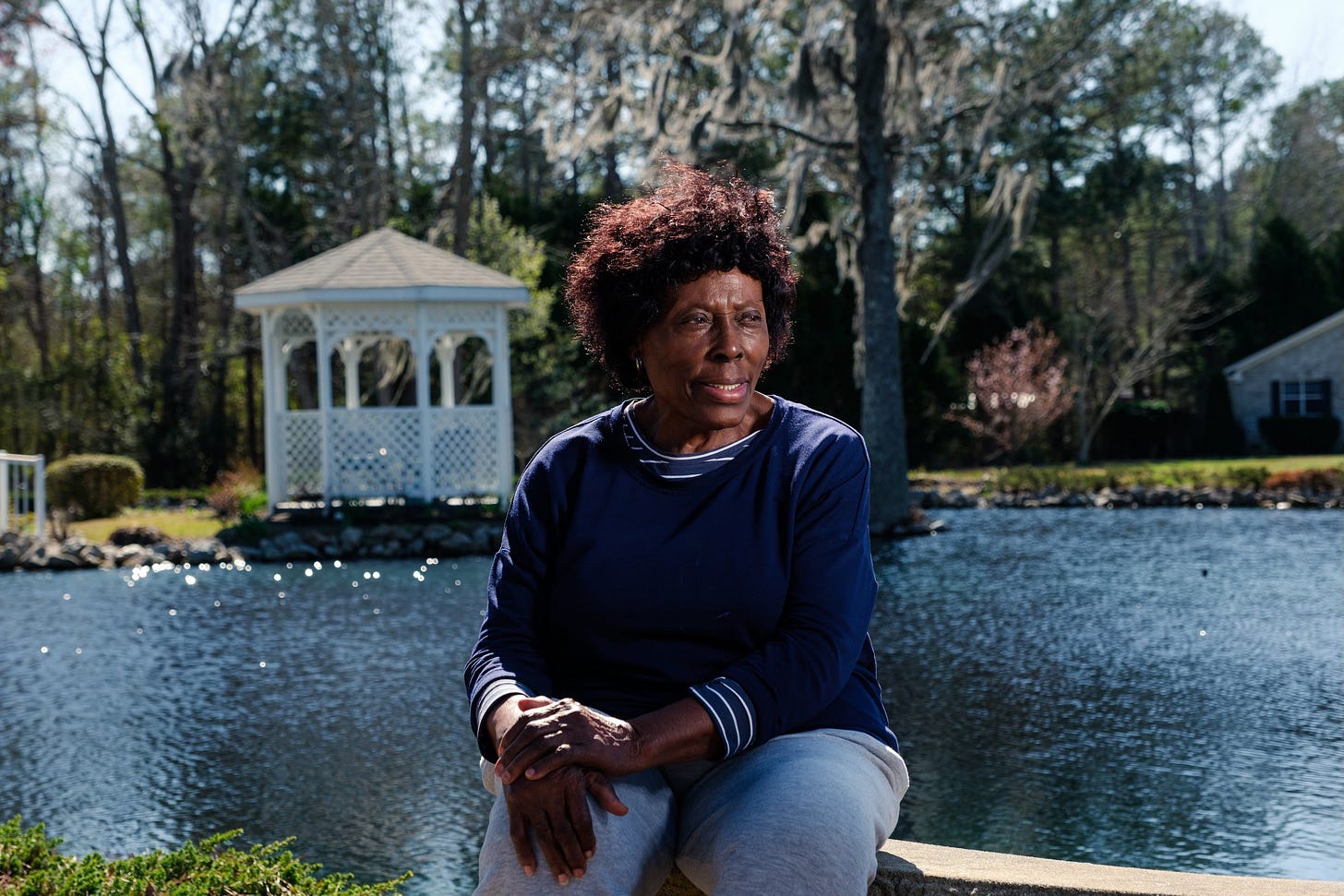
Pine needles crunch as Mary Owens walks through a cemetery just outside her hometown of Bucksport, South Carolina. She weaves between more than a hundred graves. Some are marked with seashells, but most have no formal markers, just soft depressions where time has pressed down wooden caskets.
Many of those buried here were enslaved on nearby plantations in the 1800s. They drained swamps and harvested trees under excruciating conditions, building one of the largest timber economies in the state. Their descendants still live in Bucksport.
Owens has always been interested in history, and about 20 years ago began looking for her great-grandfather’s grave. The search took her to this graveyard. It was hidden under thick brush, known to her ancestors as Eddy Lake Cemetery, and it adjoins the Tip Top plantation, once owned by Henry Buck, the largest enslaver in the region.
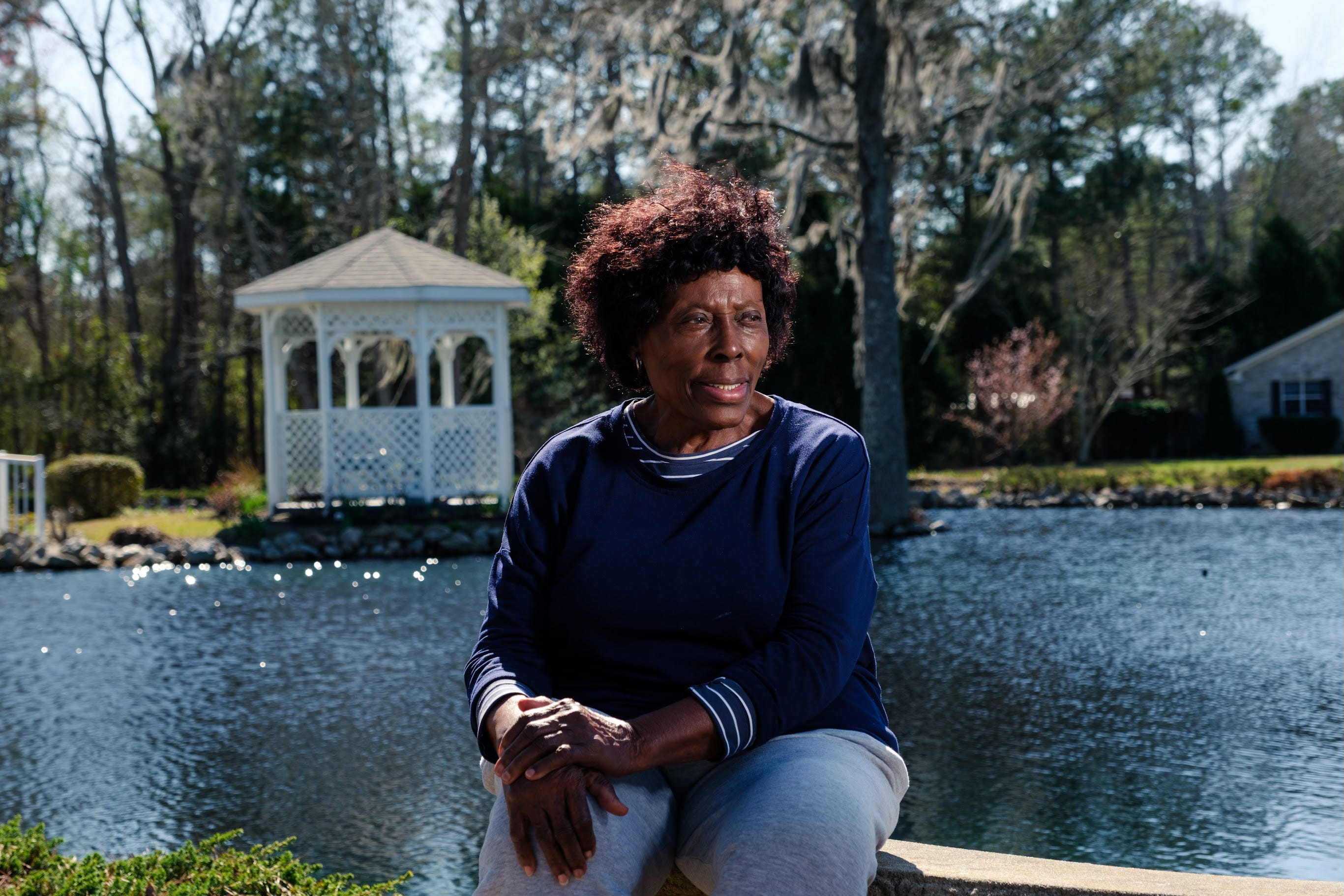
Mary Owens reflects on her family’s life in Bucksport at her home.
Around the same time she rediscovered the cemetery, Owens also began hearing about a proposed highway project. The proposal, called the SC Highway 22 Extension, includes a 28-mile, four-lane highway and bridge connecting the coast with the interior at an estimated cost of between $1.5 billion and $2.5 billion. A number of the proposed potential routes go right by the Eddy Lake Cemetery.
On maps, Bucksport is just 10 miles from Myrtle Beach, which draws 18 million tourists annually. The Waccamaw River running between the two has long buffered the historically Black community from the rapid development that transformed the coast. But all of that is changing.
…
After emancipation, Black families here bought property, built churches, and developed deep ties to the land. They banded together to survive the discrimination of Jim Crow and carved out a self-sufficient community that looks after its own.
Owens wants the community’s past to endure. She has cleared brush from Eddy Lake Cemetery and is pushing for it to be recognized as a historic site along the Gullah Geechee Cultural Heritage Corridor.
Change is inevitable, she said, but who does that change prioritize? The cemetery is one of the few tangible connections between descendants and their enslaved ancestors. For many, protecting it and the community is a moral obligation, so they attend government meetings, advocating for their voices to be truly heard.
***
Even with the steady rumble of construction vehicles, Owens refuses to let history be erased. She worked with neighbors Leatha Carson and Clementine McCray to create a 329-page historical collection, Hidden History and Experiences About Black People, to preserve records and family trees.
“We wanted our students, our kids, to know about this area,” said Owens. “We want them to try and keep it because we struggled so hard to get it.”
“We don’t want to allow history to evaporate or be buried with us,” said Carson.
Helen Phillips Pitts’ family has lived in Hampton Roads for generations, their roots sunk deep into the tidewater soil. Her grandfather, John Mallory Phillips I, was one of Hampton’s most successful oystermen, with seven boats, his own oyster beds, and even a hardware store.
…
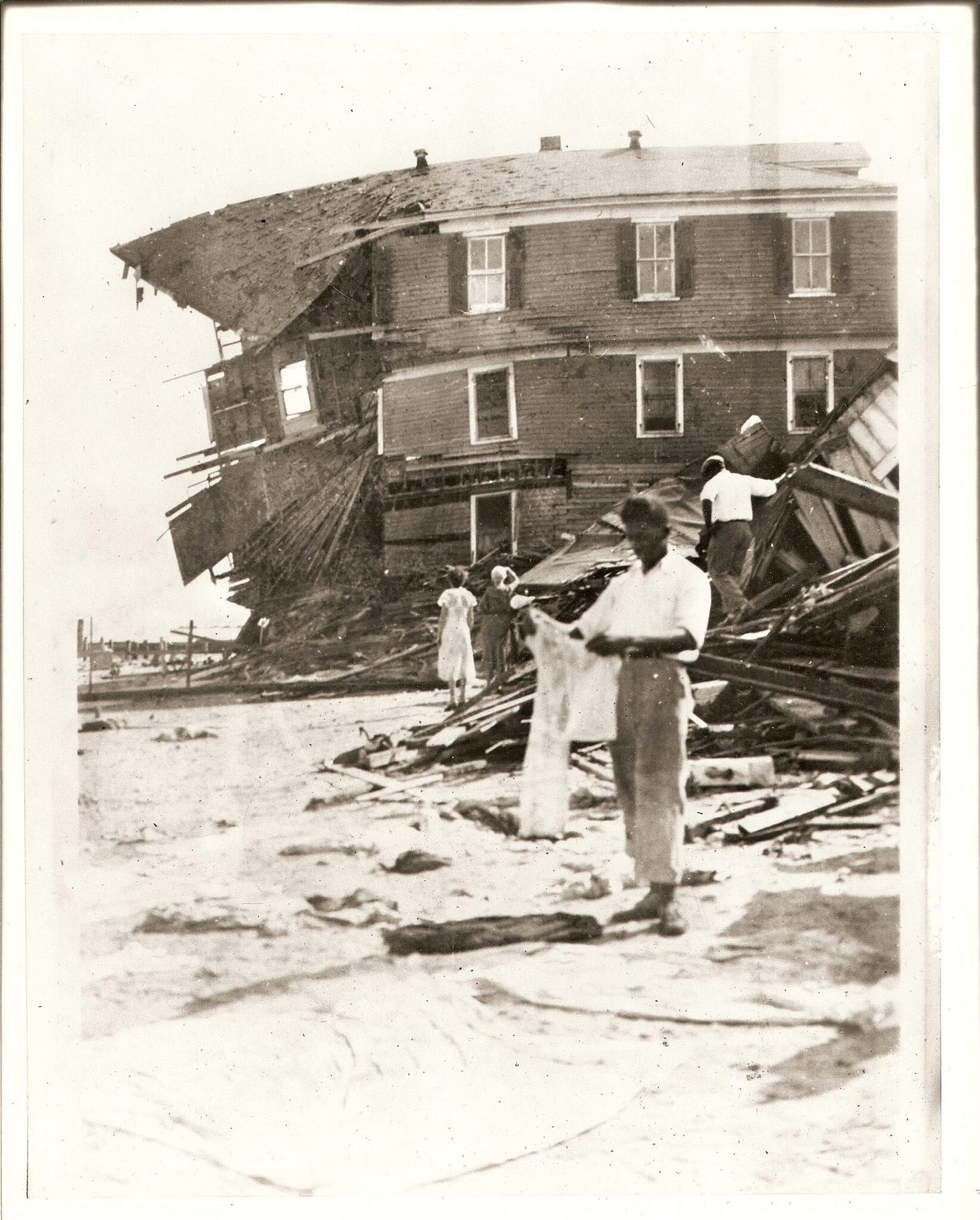
By 1898 Phillips partnered with other Black graduates from the Hampton Normal and Agricultural Institute to purchase a plot of land on the same site as what once was the largest plantation in the area. There they opened the Bay Shore Hotel, a destination resort for Black people that had extensive draw.
Water has been the family’s sustenance. It’s how they lived, worked, and rose. But now, it is also what threatens to take everything away.
Pitts remembers the floods of Hurricane Isabel in 2003. “All of downtown Hampton—not just people that were on the creek, but all the way around—people couldn’t even get out of there if they didn’t pay attention,” she said of the flooding. “In 1954, it only came up to my house, three houses away from the creek. Now, the whole of downtown Hampton floods. [Because of the impacts of] the climate—it’s crazy now.”
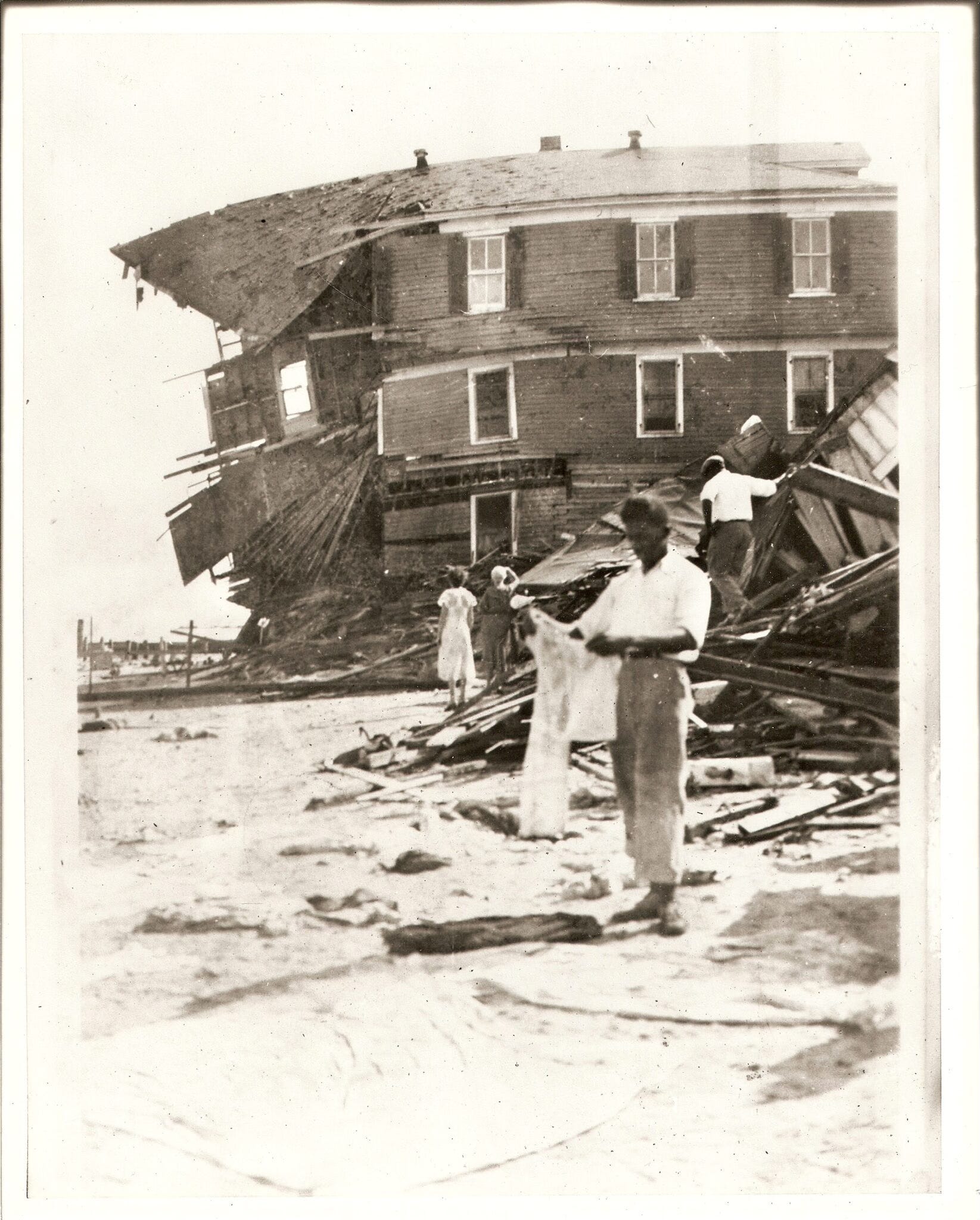
Courtesy of the Hampton History Museum, Hampton, Virginia.
…
Cassandra Newby-Alexander, professor of history at Norfolk State University, said Hampton Roads wasn’t like the big tobacco plantations farther inland. “The waterways, more than anything else, defined the economy,” she said.
Shipbuilding, fishing, trade. Enslaved people weren’t just laboring in fields; they became skilled watermen. They learned to navigate, to build and repair ships, to harvest oysters, and those skills became their form of power.
That knowledge flowed straight into freedom. Thousands of enslaved Black people escaped to the Union-held Fort Monroe during the Civil War, where they were declared “contraband of war.” As the war ended, a couple of miles away, they built a thriving community in Hampton’s ruins, laying the foundations for Hampton Normal and Agricultural Institute—now Hampton University.
And Hampton was not alone. Strong Black neighborhoods emerged across Hampton Roads. Yet even as those communities flourished, the same power structures that once enforced bondage began rewriting the rules of land and ownership.
“Because of who was controlling the municipalities, you saw planning commissions and city councils making laws that harmed Black communities,” said Newby-Alexander. “Virginia Beach, for example, had dozens of Black communities—30, 50 maybe. And over the years, the city used racial policies to erase them.”
In the early decades of the 20th century, Black landowners who wanted to build or expand homes were told they’d have to pay for their own water and sewer lines—something white landowners never faced. As soon as those Black families sold their property, she said, the city would immediately bring in the infrastructure—on the city’s dime.
…
In Norfolk’s historically Black neighborhood of Berkley, Kim Sudderth, chair of Norfolk’s Planning Commission, has spent years advocating for flood protection.
The streets in Norfolk consistently flood, and when the U.S. Army Corps of Engineers announced a multibillion-dollar flood protection project, Sudderth hoped her community might finally get some relief. But the 2019 feasibility study left Berkley out.
But those historically left out often face more of the same. The redlining policies that suppressed property values are now used to justify withholding flood protection from those same communities.
“They told us that to address the needs of our neighborhood, it would cost more than the property it would protect,” she said. “Eighty years ago, this neighborhood was redlined; there were very limited places where we could live, and our property values were deliberately stunted. Now they’re using those same low values against us.”
Durham, North Carolina, was once home to the Hayti District, a busy “Black Wall Street,” or economic hub for its Black community. Hayti was founded following the Civil War by formerly enslaved Black people from nearby plantations, including one of the largest plantations in the state, Stagville. The economic and cultural hub grew into a haven for Black people in North Carolina and along the East Coast.
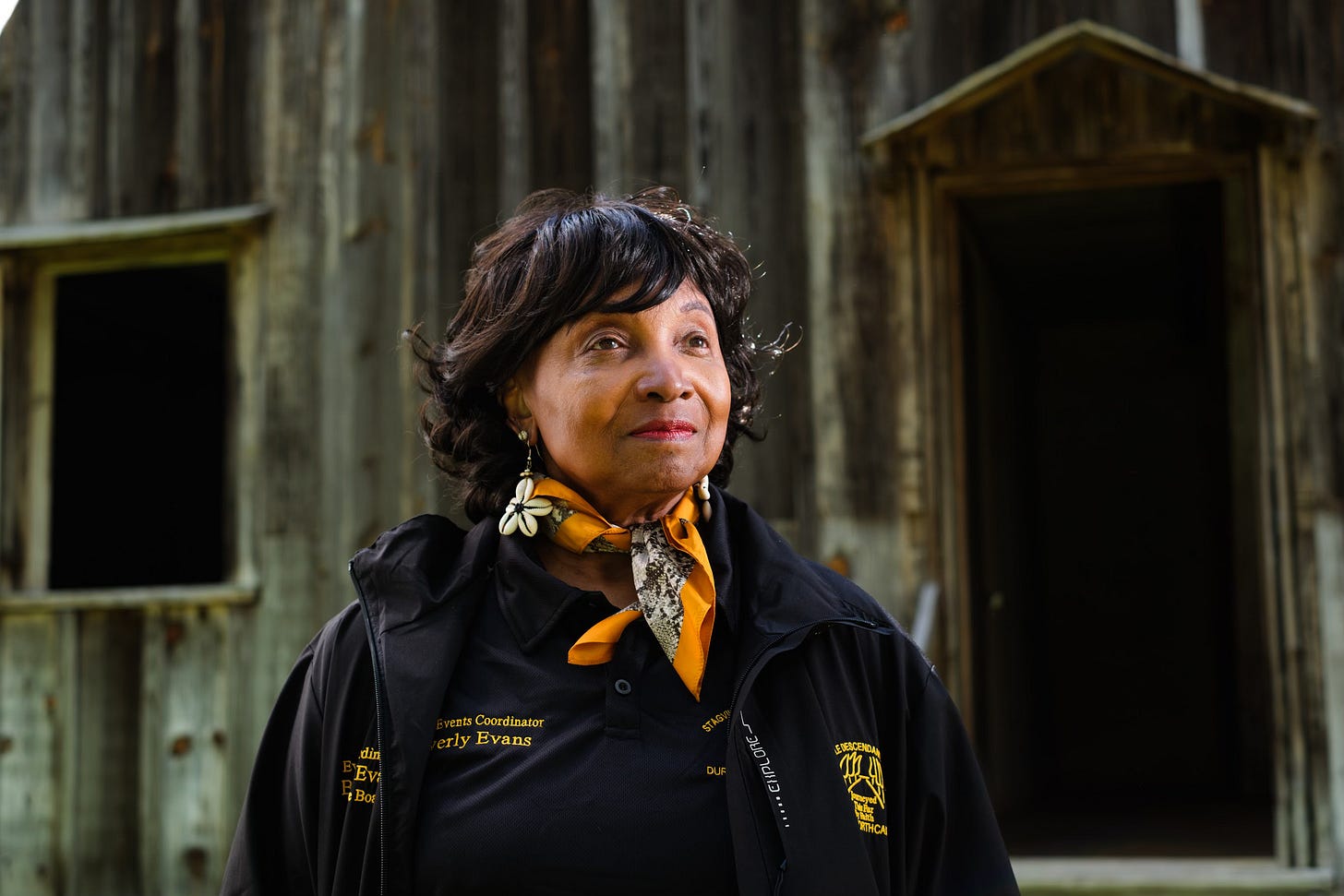
Beverly Evans fondly remembers growing up just south of Hayti and visiting her grandparents and other relatives, as well as her church, White Rock Baptist Church.
Her childhood was full of bike rides through woods and “undeveloped areas” searching for salamanders and frogs, picking blackberries and pomegranates that grew wild.
“I had that freedom as a child to explore nature and be interested in nature because it was all around me,” Evans said.
…
However, the world Evans grew up in no longer exists, and driving around what was previously the Hayti District, it’s easy to see why. It’s hard to get around without a car, and harder for children to safely bike and walk as she once did. Traffic into and out of the city covers the predominantly Black community with tailpipe pollution. Major highways cut neighbors off from food, economic resources, and each other.
It wasn’t always this way. But one massive land-use decision changed all of that: the development of the Durham Freeway and NC 147 (the northern half of the freeway).
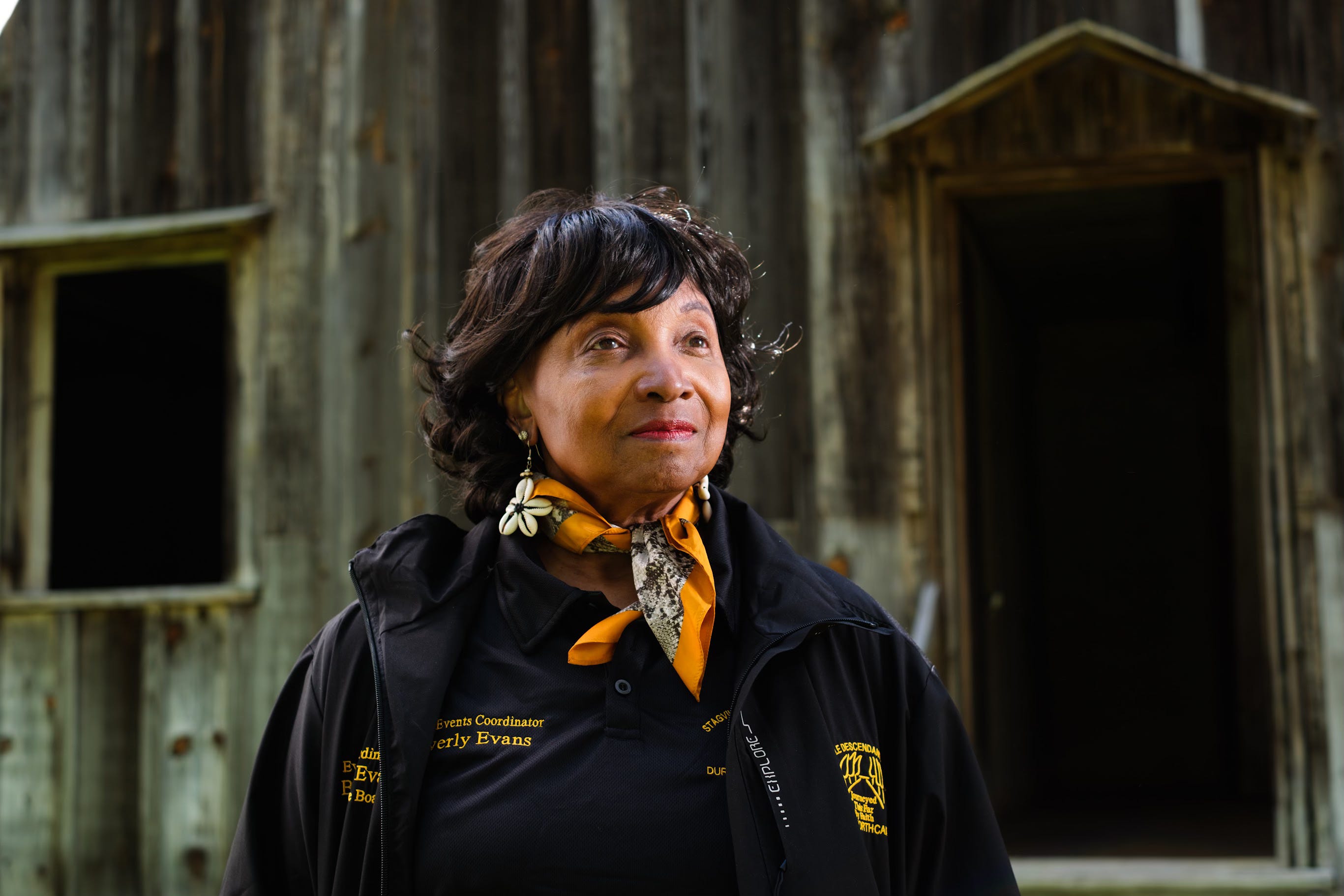
Beverly Evans is an environmentalist and activist. Her family has deep roots in Durham.
Evans and Ricky Hart trace their families’ roots to Stagville, once home to over 900 enslaved people.
Evans and Hart can’t help but feel connected to the history of the place. They point out fingerprints of enslaved children still visible on bricks at Stagville.
Evans remembers the pride that permeated the city.
“We were just very self-sufficient. And whatever one needed, there was always someone you could go to and get that done. People were thriving. Business was thriving,” Evans said.
…
The construction of 147 decimated Hayti, destroying as many as 500 homes and businesses
.
Tyra Dixon, artistic director of the Hayti Heritage Center, recalls one family that was never made whole after losing its business to the highway’s construction.
“Ms. Marcia’s family owned a beauty and barber supply business on Pettigrew Street that was demolished, and it was part of that promised reconstruction of the neighborhood once the construction was done, and it never came to fruition. They never repaid those people for losing their businesses or anything. Their business was just bulldozed,” she said.
Ricky Hart expressed a similar sentiment, saying, “When 147 was developed, it went through the economic heart of the Black community. That’s where they thrived, in that area. If you destroy the economic base of a group of people, you will disintegrate their ability to do for themselves.”
The costs go beyond homes and businesses. Communities lose health, culture, and a sense of place.
….
As Durham continues to grow and experience the tensions that come along with it, remnants of Hayti remind those keeping history alive, like Evans, Hart, and Dixon, of what’s at stake. Steps that once led to homes owned by Black families now lead to empty foundations. More than a few older businesses sit vacant as a new generation of entrepreneurs tries their luck in the city that sociologist, historian, and activist W.E.B. DuBois once highlighted as an economic model for other Black communities.
Interview between journalist Priyanka Runwal and Chandra Taylor-Sawyer, senior attorney at SELC who leads the nonprofit’s environmental justice initiative, on how plantation landscapes continue to shape communities across the American South.
As the nation commemorates 250 years of independence, what are you reflecting on?
At the 250th year, we’ve seen the recent rollback of a lot of protections. When America was founded, many of the signers of the Declaration of Independence were slave owners. At least a fifth of the population were enslaved people. Two hundred and fifty years later, my reflection is, unfortunately, we still have a long way to go. And at the same time, this is my America; this is our America. And it is worth fighting for.
With that historical context in mind, what do modern day environmental disparities look like?
The legacy of systemic racism and ongoing discrimination makes all Black communities less resilient in the face of any environmental harm. And the collective can only be as resilient as its most vulnerable parts. When communities have less access to capital—historically, their wages haven’t kept up; they have fewer hospitals and emergency services; they’re less likely to be insured and already have health disparities—they’re going to be less resilient in the face of any environmental harm. Whether that’s exposure to the carcinogen ethylene oxide for which protections are proposed to be rolled back, or the impacts of constructing new road projects and, now, data centers.
How did former plantation landscapes become industrial corridors/hubs? Could you give a few concrete examples of places and policies that made way for such land use change.
Formerly enslaved people often settled near the places where they had been enslaved. In Durham, emancipated slaves of the Stagville plantation established Hayti, which became a thriving Black economic center. They started salons, banking institutions, and systems of support.
What followed was not inevitable—but it became common.
Mid-century federal urban renewal initiatives often targeted Black American neighborhoods for redevelopment. In Hayti, despite vitality, this opened the door to the construction of the Durham Freeway, destroying homes and businesses and leading to the loss of land and social ties.
This story is not singular; it’s a pattern in Plantations to Pollution. Once neighborhoods are systemically devalued, market forces then drive industries to set up in those same corridors. Land becomes relatively inexpensive and zoning changes are made to enable heavier industrial use, leaving Black communities disproportionately exposed to harmful pollution.
How does secure ownership—or the lack thereof—shape environmental vulnerability?
One clear example of how ownership shapes community vulnerability can be viewed through the eyes of post-flood recovery. For instance, homeowners are more likely to have private insurance that will pay out to replace real and personal property. Meanwhile, a renter may have rental insurance to replace personal property but are more likely to be left to their own devices in terms of finding another place to live. Owners who can demonstrate clear title to their property also receive more federal emergency aid than renters. The agency’s primary assistance ties aid to physical property damage, so homeowners get larger amounts of direct compensation.
Ownership isn’t simply about wealth. It determines whether families can remain in place, recover from disasters, and resist unwanted development.
How are people fighting back?
The places that have experienced disproportionate burdens of environmental harm are still making their voices heard, even in the face of less federal infrastructure that supports those protections.
All over the South, we’re seeing people pushing backagainst data centers. They’re saying, ‘We want more information about these facilities; we need to know fully what to expect.’ And they’re requesting to pull the brakes before allowing these facilities to enter our neighborhoods because ‘We don’t know what the ultimate outcomes are going to be, on our health, on our economic future.’
How can Hothouse’s readers help?
I’m really serious when I share that people should not become mired in despair. There were too many lives lost to get to where we are today to be mired in despair.
So practically, I’m excited. I want people to look at our Plantations to Pollution multimedia storytelling project. I think that there is so much there to become familiar with, to get knowledgeable on. I also think that people can support environmental justice organizations—either with their money, with their volunteer time, with their particular skill sets—because these groups are under-resourced.Make sure that we let decision makers know that we expect representation that actually shows up for us and that we expect accountability.
Academics can support scholarship that could provide the background to show why we should be helping heirs’ property owners—editor’s note: At the height of Black land ownership in America in 1910 at 15 million acres, 81 percent of those landowners did not have wills. These lands became known as heirs’ properties, lacking legal protections and were vulnerable to forced sales.—These heirs’ property owners are particularly vulnerable after a storm, for example, if they can’t prove they own the land and are thus less likely to be able to access resources from FEMA or any emergency relief. They’re much more vulnerable to their land being taken by eminent domain,to be purchased well below market rates, to be preyed upon by developers or used for encroaching polluting facilities.
Any last reflections?
So 250 years ago, the founders of America were fighting to make sure that they were heard. At this 250-year anniversary, with all the efforts to redistrict, to reduce the voting power of Black communities, we should also not be silent. Pay attention, push back, make sure your voice is heard.
*This interview has been edited for length and clarity.
Ways to contribute
Potential climate justice organizations to contribute to, with links to their profiles on Candid, formerly GuideStar, a platform dedicated to evaluating nonprofit track records.