

Welcome to Carbon Brief’s DeBriefed.
An essential guide to the week’s key developments relating to climate change.
This week
UK proposes new emissions target
‘ON COURSE’: The UK government has proposed reducing the country’s greenhouse gas emissions to 87% below 1990 levels by 2040, reported the Associated Press. The newswire cited scientists saying that the goal “puts the UK on course to meet its 2050 net-zero target”. To meet this target, the UK would “need to invest around £880bn over 25 years…but doing so would yield benefits worth £1,620bn”, according to an in-depth analysis of the plans by Carbon Brief.
UPCOMING ‘FLASHPOINT’: The Financial Times noted that, for the target to become “legally binding”, it must be approved by parliament. While the UK’s previous carbon budget “received cross-party support”, this time the proposal is “expected to become a flashpoint among lawmakers”, it added, with both the Conservatives and Reform pledging to “scrap” net-zero policies.
DRIVING FORCE: Separately, a new report by consultancy Confederation of British Industry (CBI) Economics has valued the UK’s “net-zero economy” at more than £100bn a year, reported the Guardian. It added that, by a broad measure, the UK energy transition supports 1.1m jobs and provides “nearly 4% of the UK’s economic output”.
US ‘dismantling’ oceans data
SYSTEMS OFFLINE: The Trump administration is “dismantling” a “$368m deep-ocean observation system” that, among other things, allows scientists to monitor the ocean currents that affect the global climate and understand how the “ocean is absorbing greenhouse gases from the atmosphere”, said the New York Times. Bloomberg reported that Trump’s efforts to close the National Center for Atmospheric Research (NCAR), a key climate science research institution, has been “temporarily blocked” by a judge.
RULE ROLLBACK: The US Securities and Exchange Commission (SEC), an independent body that regulates US securities markets, has proposed repealing the climate-disclosure rule, which “requires some public companies to report their greenhouse gas emissions and the risks they face from global warming”, said the Associated Press. The Trump administration also announced plans to allocate $700m to support “clean, beautiful coal” power and export infrastructure, said BBC News.
Around the world
- EU EXEMPTIONS: The EU will allow member states to breach the bloc’s fiscal rules to “cope with high energy prices stoked by the Iran war”, as long as the measures they use help “accelerate the transition away from fossil fuels”, reported Bloomberg.
- SLOW SPENDING: The German government has only paid out €24bn of the €37bn it was “supposed to disburse” in 2025 from a special fund for infrastructure and “climate neutrality”, reported Clean Energy Wire.
- URGENT WARNING: UN secretary-general António Guterres said a likely upcoming El Niño weather event must be treated as the “urgent climate warning it is”, said Al Jazeera.
- HOEKSTRA ON COP: The outcomes of many of the most recent COPs have been “underwhelming”, EU climate commissioner Wopke Hoekstra has said, according to Reuters. COPs should be supplemented by “smaller groups…who are willing to move faster”, he added.
3,400
The number of excess deaths across India caused by a single day of extreme heat, according to coverage in the Hindustan Times of a new study.
30,000
Excess deaths caused if the extreme heat lasts five days.
Latest climate research
- In a 1.5C warmer world, the timing of floods will shift by more than seven days across half of the world’s landmass | Nature Communications
- Temperature and rainfall together account for more than 13% of methane generated from landfills in Incheon, South Korea | Atmospheric Chemistry and Physics
- The postponed International Maritime Organisation “net-zero framework” could increase biofuel use in shipping to 40% by 2050 | Nature Energy
(For more, see Carbon Brief’s in-depth daily summaries of the top climate news stories on Monday, Tuesday, Wednesday, Thursday and Friday.)
Captured
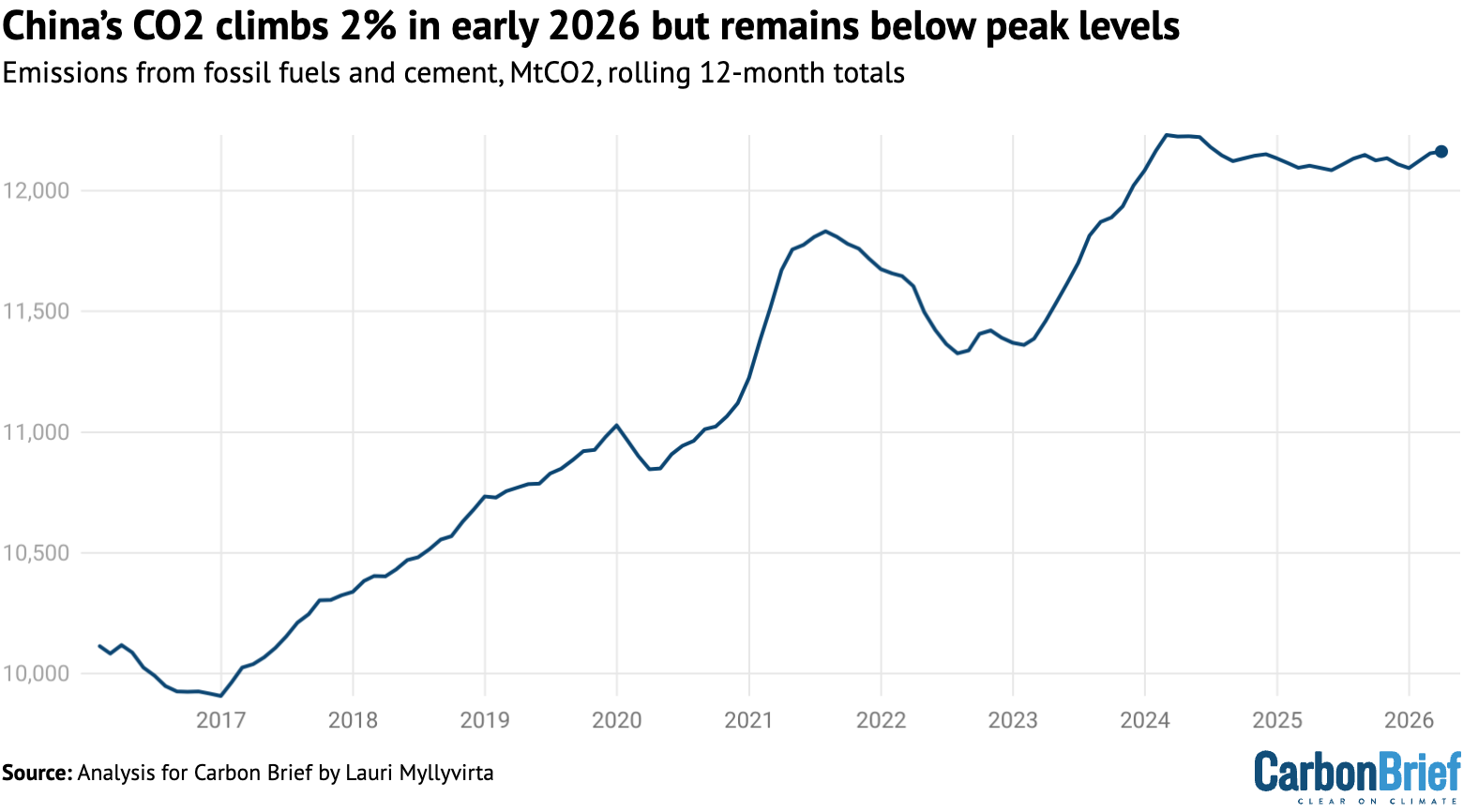
China’s carbon dioxide emissions grew by 2% in the first quarter of 2026 due to a rise in “wasted” wind and solar generation, according to new analysis for Carbon Brief. However, emissions remain below their March 2024 peak, it added.
Spotlight
Why China’s solar boom is slowing down
China made headlines in 2025 for installing record levels of solar. But in 2026, new capacity is expected to be lower than last year’s figures.
This week, Carbon Brief examines what is behind China’s lower 2026 solar additions.
Solar power has been a major element of China’s renewables buildout since the mid-2010s.
The country installed 315 gigawatts (GW) of new capacity in 2025, adding more than half of all new solar globally. The year before, it added 277GW.
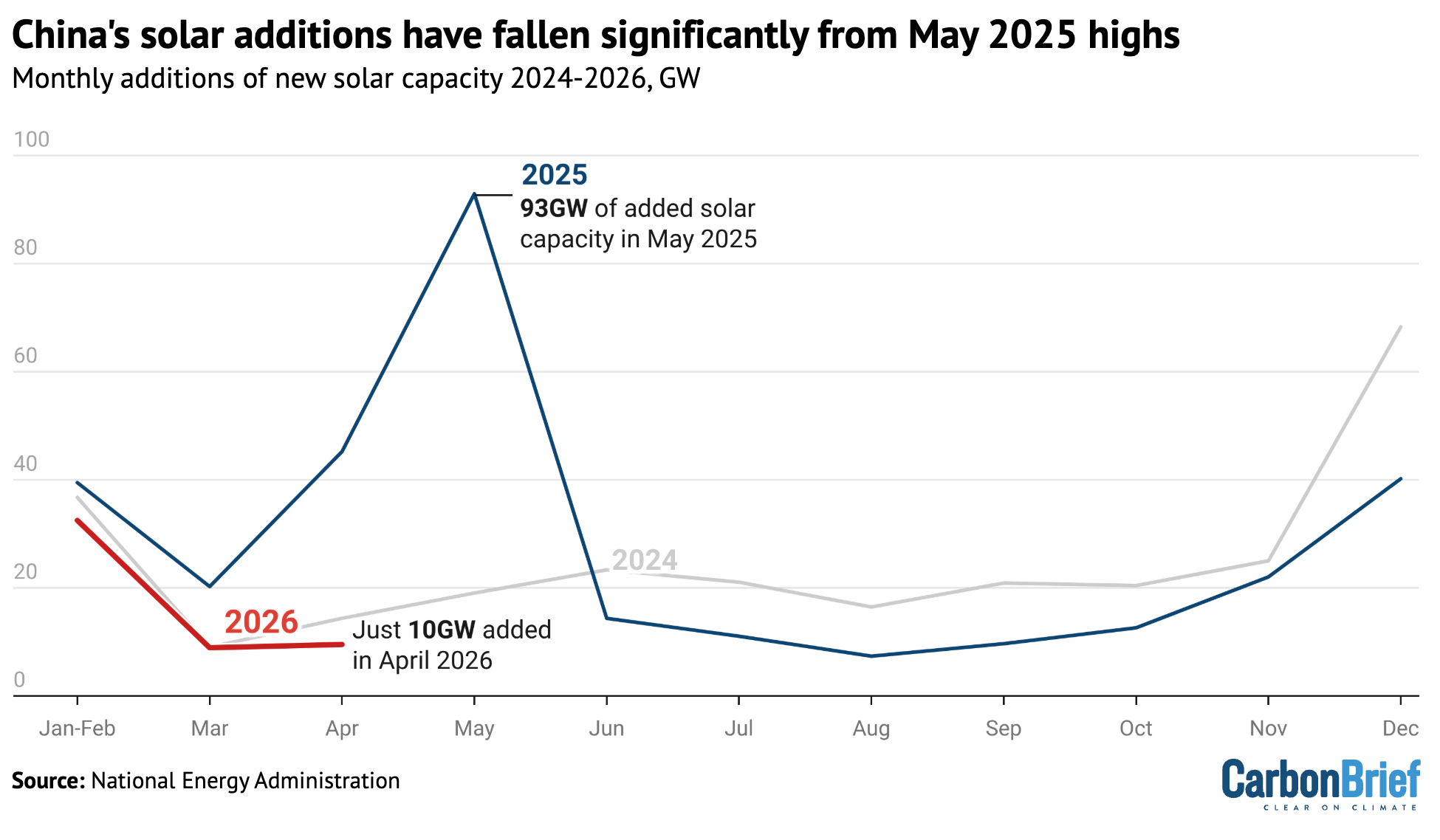
But the picture in 2026 to date is very different. Installations in March fell 56% year-on-year to 9GW, while new capacity in April totalled 10GW, a 79% drop compared to a year earlier, according to Carbon Brief’s analysis of official data.
Domestic uncertainty
The lower pace in 2026 had been anticipated by analysts.
In previous years, massive solar installations were driven by strong policy support for renewables, including a fixed-price tariff for generators.
In February 2025, the government announced that new solar and wind projects would instead be financed through a new “contract for difference” (CfD)-style system.
Under the new system, power from a certain amount of renewable capacity will be purchased for a fixed “strike price”, which to date has been far lower than previous guaranteed tariffs. Further projects will need to secure their own contracts on the open market.
While the new system is posing challenges for developers in the short term, it is part of a longer-term shift towards market-driven pricing for renewables, which has already made them cheaper than coal.
The change led to a rush of new project installations ahead of the June 2025 cut-off date, so that they could fall under the old fixed-price regime.
New solar additions totalled 45GW in April 2025 and 93GW in May 2025, before falling to 14GW in June 2025, according to Carbon Brief analysis of government data.
Additions also spiked in December, in both 2024 and 2025, as developers raced to meet completion deadlines including those under the 14th five-year plan.
Some reports have attributed the precipitous drop this year to falling demand for solar in China.
But this is a “major oversimplification”, David Fishman, principal at energy consultancy the Lantau Group, wrote on LinkedIn.
The real challenge, he said, is that “developers and banks [are] still figuring out how to finance and build projects without policy-backed revenue guarantees”.
Yang Biqing, energy analyst for Asia at thinktank Ember, agrees, telling Carbon Brief that the new CfD-style system has created “greater uncertainty” for developers, compounded by fierce competition and a growing push for “consolidation” in the industry.
The government set a target for 200GW of new solar and wind capacity in 2026.
Fishman told Carbon Brief that this will be “difficult” for the government to achieve, though not impossible. Current levels of solar additions – reaching perhaps 120GW for the year – plus an “ambitious” 80GW of new wind power, could help China to hit the target, he said.
Others are more bullish. The China Photovoltaic Industry Association forecasts 180-240GW of new solar in 2026.
But few believe additions will match the breakneck pace of 2025.
“China’s solar industry is no longer a story of capacity expansion”, said Yang, with officials now “increasingly” focused on integrating current generation into the grid.
Soaring exports
Meanwhile, China’s solar exports are still going strong.
China exported almost 1.2m tonnes of solar cells in April 2026, according to Reuters. Although down from a record high in March, it represented a 60% rise year-on-year, added the newswire.
This signals solar’s attractiveness globally in the face of rising energy prices caused by the Iran-US conflict, analysts have said.
High demand for panels has been reported across several continents, including Europe, Asia and Africa.
For example, in the Philippines, the conflict is “driving” solar uptake, one analyst told the Associated Press, adding:
“People want solar and people want solar now.”
A version of this article is also available on the Carbon Brief website.
Watch, read, listen
EL NIÑO IMPACTS: An interactive piece from BBC News described how the forecasted “super” El Niño could impact global climate and weather in the coming months.
‘CAUTIONARY TALE’: Two researchers wrote in Climate Home News that “Indonesia’s failing Just Energy Transition Partnership is a cautionary tale”.
‘CULTURE WAR’: Time magazine spoke to London mayor Sadiq Khan about how he “survived the climate culture war”.
Coming up
- 8 June: World Ocean Day
- 8-18 June: Bonn climate talks, Bonn, Germany
- 11 June: Climate Adaptation Innovation in Latin America and the Caribbean webinar, online
Pick of the jobs
- The New York Times, climate policy correspondent | Salary: $124,980-$160,000. Location: Washington DC
- Regulatory Assistance Project, associate, electricity systems and electrification | Salary: €50,000-€60,000. Location: Madrid and remote
- Future Energy Networks, head of policy | Salary: £75,000-£100,000. Location: London and remote
DeBriefed is edited by Daisy Dunne. Please send any tips or feedback to debriefed@carbonbrief.org.
This is an online version of Carbon Brief’s weekly DeBriefed email newsletter. Subscribe for free here.
The post DeBriefed 5 June 2026: UK eyes 2040 emissions cut | US ‘dismantling’ oceans research | China’s solar slump appeared first on Carbon Brief.